425 posters, 1 videos, 9 audios, 8 topics, 53 sessions, 340 authors, 286 institutions
ePostersLive by SciGen Technologies S.A. All rights reserved.
22nd Annual Pain Medicine Meeting 2023
November 10 - 11, 2023 | New Orleans Marriott | New Orleans, Louisiana, USA

4744
EFFICACY RATE OF REPEAT LUMBAR INTERLAMINAR AND TRANSFORAMINAL INJECTIONS WITHIN TWO-MONTH PERIOD: A RETROSPECTIVE REVIEW.
Poster Presenter
Authors
Affiliations
Part of Topic
Chronic Pain
Efficacy and complication rate of repeat lumbar interlaminar and transforaminal injections within two-month period: a retrospective review.
Christian B. De Allie1, MD, MBA; Manraj Dhesi1, MD; Sh’Rae Marshall1, MD; Jeffrey A. Gehret2, DO; David S. Stolzenberg2, DO; Paul M. Kitei2, MD; Jeremy I. Simon2, MD
1Department of Rehabilitation Medicine, Thomas Jefferson University, Philadelphia, PA, USA
2Department of Physical Medicine and Rehabilitation, Rothman Institute/Thomas Jefferson University Hospital, Philadelphia, PA, USA
Introduction:
Back pain is a common complaint that impacts ~80% of all individuals in their lifetime.1 It can be categoriConfirm and proceed »zed into acute and chronic, which can be further subcategorized by location along one's back. Trained clinicians are vigilant to associating red flags, such as incontinence, sensory or motor changes, and a cancer diagnosis.2 The presence of a red flag should prompt further evaluation, likely including new imaging. Back pain without red flags can be alleviated through non-pharmacologic measures; however, medication administration may be warranted in many cases. There are several modalities that have demonstrated moderate benefit, in terms of short-term treatment of back pain, including NSAIDS and opioids.2
There are common medical conditions that cause painful low back pain and radiculopathy such as disc herniation, lumbar spinal stenosis, and discogenic pain. After failing conservative management including oral medications and physical therapy, patients may benefit from epidural steroid injections (ESI). Two common approaches for ESI are the interlaminar and transforaminal approaches. A transforaminal ESI has been proven efficacious in treating patients with disc herniation with some studies suggesting greater relief compared to the interlaminar approach.3,4 After an unsuccessful first injection, another approach or another steroid medication can be administered with hopes for better outcomes.
Methods:
A retrospective analysis was performed by reviewing electronic chart records. Inclusion criteria included individuals greater than the age of 18 who received a lumbar interlaminar or transforaminal ESI between January 1st 2019 to July 1st 2022 and another epidural injection less than two months after the first injection. Exclusion criteria included individuals that had prior spine surgical procedures or recent epidural spine injection within 3 months. The primary outcome assessed was the rate of success depending on the level of intervention, medication used, and the route used for medication administration. An injection is successful if the patient reports 50% or greater pain relief during their first follow-up after their procedure.
Results:
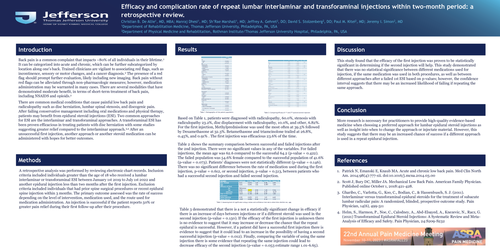
Based on Table 1, patients were diagnosed with radiculopathy, 60.0%, stenosis with radiculopathy 23.2%, disc displacement with radiculopathy, 10.0%, and other, 6.82%. For the first injection, Methylprednisolone was used the most often at 39.5% followed by Dexamethasone at 32.3%. Betamethasone and triamcinolone trailed at 26.8%, 0.45%, and 0.91% . The first injection was efficacious 23.6% of the time.
Table 2 shows the summary comparison between successful and failed injections after the 2nd injection. There were no significant values in any of the variables. For failed injections, the mean age was 62.6 compared to the successful 64.2 (p-value = 0.422). The failed population was 54.6% female compared to the successful population of 41.6% (p-value = 0.073). Patients’ diagnoses were not statistically different (p-value = 0.146). There was no significant difference between the rate of medication used during the first injection, p-value = 0.612, or second injection, p-value = 0.513, between patients who had a successful second injection and failed second injection.
Table 3 demonstrated that there is a not a statistically significant change in efficacy if there is an increase of days between injections or if a different steroid was used in the second injection (p-value = 0.150). If the efficacy of the first injection is unknown there is no evidence to suggest that it may increase or decrease the chance that the repeat epidural is successful. However, if a patient did have a successful first injection there is evidence to suggest that it could lead to an increase in the possibility of having a second successful injection (p-value = 0.012). Finally, comparing the variable of using the same injection there is some evidence that repeating the same injection could lead to decrease efficacy of the second injection (p-value = 0.053 estimate range 1.01-6.65).
Discussion:
This study found that the efficacy of the first injection was proven to be statistically significant in determining if the second injection will help. This study demonstrated that there was no statistical significance between different medications used for injection, if the same medication was used in both procedures, as well as between different approaches after a failed 1st ESI based on p-values; however, the confidence interval suggests that there may be an increased likelihood of failing if repeating the same approach.
Conclusion:
More research is necessary for practitioners to provide high-quality evidence-based medicine when choosing a preferred approach for lumbar epidural steroid injections as well as insight into when to change the approach or injectate material. However, this study suggests that there may be an increased chance of success if a different approach is used in a repeat epidural injection.
Resources: