425 posters, 1 videos, 9 audios, 8 topics, 53 sessions, 340 authors, 286 institutions
ePostersLive by SciGen Technologies S.A. All rights reserved.
22nd Annual Pain Medicine Meeting 2023
November 10 - 11, 2023 | New Orleans Marriott | New Orleans, Louisiana, USA

4613
IDENTIFYING THE IMPACT OF CENTRALIZED PAIN ON PAIN OUTCOMES AFTER INTERVENTIONAL PAIN PROCEDURES
Poster Presenter
Authors
Affiliations
Part of Topic
Chronic Pain
Identifying the Impact of Centralized Pain on Pain Outcomes after Interventional Pain Procedures
K. Matt Castinado, MD*; Vincent Ho, MD; John Gaumnitz , MD ; Miranda McMillan, MSc*; Andrea L. Chadwick , MD, MSc*
*Department of Anesthesiology, University of Kansas School of Medicine
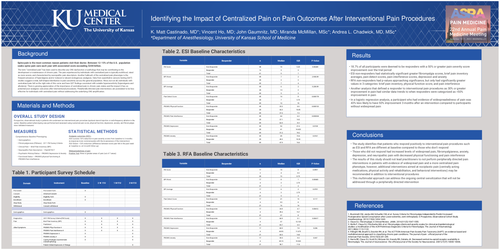
The term “centralized pain” has been used to describe any CNS dysfunction or pathology that may be contributing to the development or maintenance of chronic pain. The pain experienced by individuals with centralized pain is typically multifocal, rated as more severe, and characterized by neuropathic pain descriptors. Another hallmark of the centralized pain phenotype is the frequent presence of hyperalgesia and/or reduced or absent endogenous analgesia. Data from quantitative sensory testing (QST) studies suggest a wide, bell-shaped distribution in pain sensitivity across the general population. Most, but not all, individuals with centralized pain fall on the right side of this curve and have QST findings consistent with notable hypersensitivity (hyperalgesia and allodynia). There is growing appreciation of the importance of centralized pain in chronic pain states and the impact it has on potential poor analgesic outcomes after interventional procedures. Peripherally-directed pain interventions are postulated to be less effective for individuals with centralized pain without addressing the underlying CNS amplification.
18.7% of all participants were deemed to be responders with a 50% or greater pain severity score
improvement over the trial period
ESI nonresponders had statistically significant greater fibromyalgia scores, brief pain inventory
averages, pain detect scores, pain interference scores, depression and anxiety
RFA nonresponders had p values approaching significance, but only had significantly greater
values in 3 categories: brief pain inventory, physical function score, and pain interference
Another analysis that defined a responder to interventional pain procedures as 30% or greater
improvement in pain had similar data trends to when responders were categorized as >50%
improvement in pain
In a logistic regression analysis, a participant who had evidence of widespreadedness of pain
was 43% less likely to have 50% improvement 3 months after an intervention compared to participants
without widespread pain
The study identifies that patients who respond positively to interventional pain procedures such
as ESI and RFA are different at baseline compared to those who don’t respond
Those who did not respond had increased levels of widespread pain, fibromyalgianess, anxiety,
depression, and neuropathic pain with decreased physical functioning and pain interference
The results of this study should not lead practitioners to not perform peripherally directed pain
interventions in patients with evidence of widespread pain and a more centralized pain
phenotype, however, additional interventions aimed at nociplastic pain (centrally acting
medications, physical activity and rehabilitation, and behavioral interventions) may be
recommended in addition to interventional procedures
This multimodal approach can address the ongoing central sensitization that will not be
addressed through a peripherally directed intervention