425 posters, 1 videos, 9 audios, 8 topics, 53 sessions, 340 authors, 286 institutions
ePostersLive by SciGen Technologies S.A. All rights reserved.
22nd Annual Pain Medicine Meeting 2023
November 10 - 11, 2023 | New Orleans Marriott | New Orleans, Louisiana, USA

4609
PHARMACOLOGIC THERAPY SUCCESS RATE IN CANCER SURVIVORS VERSUS ACTIVE CANCER PAIN PATIENTS
Poster Presenter
Authors
Affiliations
Part of Topic
Chronic Pain
Pharmacologic Therapy Success Rate in Cancer Survivors Versus Active Cancer Pain Patients
Grimmer JE1, Bazil, T 1,2,3, Sarwan, G 1,2,3 , Bentley-McLachlan MJ1, Liu, Q1, Wen, C1, Matson, B1,2, de Leon-Casasola O1,2
1Roswell Park Comprehensive Cancer Center | 2University at Buffalo | 3Buffalo Veteran Affairs Medical Center
BACKGROUND
We have reported on the increasing number of survivors in the need for pain treatment in our cancer pain clinic.1 At that time, we documented that over 95% of the patient had pain because of post-treatment pain problems: Post-surgical pain syndromes, post-chemotherapy induced peripheral neuropathy, radiation-induced neuropathic pain, etc. Consequently, most of these patients are experiencing neuropathic pain as the main source of their pain condition1. We also reported on the role of the pain service’s clinical nurse in successfully coaching and increasing patients’ compliance when treated with anti-neuropathics2. The aim of this study was to evaluate the success rate of this approach in treating pain in both active cancer and survivors when comparing the “worst pain score” pain at the first visit versus the last visit among other measures.
METHODS
IRB approval was obtained. All new patients seen in the Roswell Park Comprehensive Cancer Pain Clinic during the month of November 2022 were identified. The patients were classified as either a cancer survivor or an active cancer patient. The Chronic Pain Acceptance Questionnaire (CPAQ) responses were reviewed to document the “current pain”, “worst pain the past week”, “least amount of pain in the past week”, and the “amount of pain you could live” levels at the initial visit, 1 month follow-up visit, and 6-month visit (May 2023). Moreover, the “level of success” of treatment was evaluated: 1= totally successful, 2= very successful, 3= moderately successful, 4= mildly successful, and 5= not successful.
STATISTICAL ANALYSIS
Independent two-sample t-test were used to test the difference in the pain scores. The null hypothesis was rejected at the p<0.05 level. Paired t-test was used to test the difference between “worst pain” in the initial visit versus the last visit. Since there were only 13 patients with data available at the first and last visit, an independent two-sample t-test was used.
RESULTS
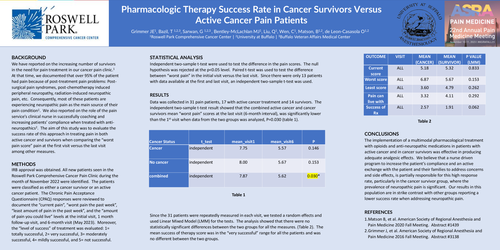
Data was collected in 31 pain patients, 17 with active cancer treatment and 14 survivors. The independent two-sample t-test result showed that the combined active cancer and cancer survivors mean “worst pain” scores at the last visit (6-month interval), was significantly lower than the 1st visit when data from the two groups was analyzed, P=0.030 (table 1).
Since the 31 patients were repeatedly measured in each visit, we tested a random effects and used Linear Mixed Model (LMM) for the tests. The analysis showed that there were no statistically significant differences between the two groups for all the measures. (Table 2). The mean success of therapy score was in the “very successful” range for all the patients and was no different between the two groups.
CONCLUSIONS
The implementation of a multimodal pharmacological treatment with opioids and anti-neuropathic medications in patients with active cancer and in cancer survivors was effective in producing adequate analgesic effects. We believe that a nurse driven program to increase the patient’s compliance and an active exchange with the patient and their families to address concerns and side effects, is partially responsible for this high response rate, particularly in the cancer survivor group, where the prevalence of neuropathic pain is significant. Our results in this population are in strike contrast with other groups reporting a lower success rate when addressing neuropathic pain.
REFERENCES