425 posters, 1 videos, 9 audios, 8 topics, 53 sessions, 340 authors, 286 institutions
ePostersLive by SciGen Technologies S.A. All rights reserved.
22nd Annual Pain Medicine Meeting 2023
November 10 - 11, 2023 | New Orleans Marriott | New Orleans, Louisiana, USA

4605
COST SAVINGS OF A DIGITAL ACCEPTANCE AND COMMITMENT THERAPY FOR FIBROMYALGIA MANAGEMENT
Poster Presenter
Authors
Affiliations
Part of Topic
Chronic Pain
Audio
Cost Savings of a Digital Behavioral Health Therapeutic for Fibromyalgia Management
Objective: To perform an economic evaluation of an FDA-cleared prescription digital therapeutic (FM-ACT) for the management of fibromyalgia symptoms.
FIBROMYALGIA AND TREATMENT:
Fibromyalgia (FM) is a chronic syndrome affecting up to 6.4% of the US population. Patients suffer from widespread pain, multiple symptoms, and co-morbid conditions. Most patients do not have access to behavioral health interventions such as cognitive behavioral therapy (CBT), which is a recommended treatment in FM guidelines with Level 1A evidence.
● Annual adoption rate of CBT in FM is only 4.5%6
● Limiting factors: lack of providers, high costs, and geographic barriers
Uncontrolled FM drives high symptom burden and healthcare over-utilization and FM patients have 3X higher healthcare costs than the average patient.
A digital behavioral intervention delivered via smartphone can improve access to care, which may in turn, lower healthcare utilization costs.
DIGITAL THERAPEUTIC DEVICE (FM-ACT):
FM-ACT is an FDA cleared, Class II prescription digital therapeutic that provides self-guided Acceptance and Commitment Therapy (ACT), a form of CBT, for treating FM symptoms.
ACT has been empirically supported for managing chronic pain, including FM. It includes training in acceptance and mindfulness skills for symptoms, together with motivation and behavior change methods to improve physical and emotional functioning and increase quality of life.
Through the 3-month treatment program and later maintenance period, patients learn and practice core ACT skills related to openness, cognitive defusion, attention management, perspective-taking, values clarification, and values-based committed action.
The program also includes other CBT-based interventions for chronic pain, including education and paced daily activities/exercise.
MODELING OF COSTS:
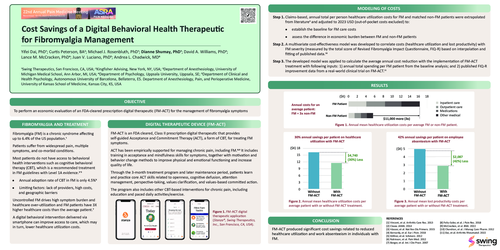
Step 1. Claims-based, annual total per person healthcare utilization costs for FM and matched non-FM patients were extrapolated from literature3 and adjusted to 2023 USD (out-of-pocket costs excluded) to:
● establish the baseline for FM care costs
● assess the difference in economic burden between FM and non-FM patients
Step 2. A multivariate cost-effectiveness model was developed to correlate costs (healthcare utilization and lost productivity) with FM severity (measured by the total score of Revised Fibromyalgia Impact Questionnaire, FIQ-R) based on interpolation and fitting of published data.
Step 3. The developed model was applied to calculate the average annual cost reduction with the implementation of FM-ACT treatment with following inputs: 1) annual total spending per FM patient from the baseline analysis; and 2) published FIQ-R improvement data from a real-world clinical trial on FM-ACT.
CONCLUSION:
FM-ACT produced significant cost savings related to reduced healthcare utilization and work absenteeism in individuals