425 posters, 1 videos, 9 audios, 8 topics, 53 sessions, 340 authors, 286 institutions
ePostersLive by SciGen Technologies S.A. All rights reserved.
22nd Annual Pain Medicine Meeting 2023
November 10 - 11, 2023 | New Orleans Marriott | New Orleans, Louisiana, USA

4556
RADIATION EXPOSURE IN PAIN MANAGEMENT PROVIDERS: A SYSTEMATIC REVIEW OF THE CURRENT LITERATURE
Poster Presenter
Part of Topic
Chronic Pain
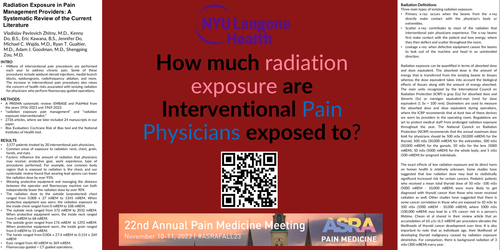
How much radiation exposureare are Interventional Pain Physicians exposed to?
Radiation Exposure in Pain Management Providers: A Systematic Review of the Current Literature
Vladislav Pavlovich Zhitny, M.D., Kenny Do, B.S., Eric Kawana, B.S., Jennifer Do, Michael C. Wajda, M.D., Ryan T. Gualtier, M.D., Adam J. Goodman, M.D., Shengping Zou, M.D.
INTRO
METHODS
RESULTS
Radiation Definitions
Three main types of ionizing radiation exposure:
Radiation exposure can be quantified in terms of absorbed dose and dose equivalent. The absorbed dose is the amount of energy that is transferred from the ionizing beams to tissues whereas the dose equivalent takes into account the biological effects of tissues along with the amount of energy absorbed. The main units recognized by the International Council on Radiation Protection (ICRP) is gray (Gy) for absorbed dose and Sieverts (Sv) or roentgen equivalent-man (rem) for dose equivalent (1 Sv = 100 rem). Dosimeters are used to measure the absorbed dose and dose equivalent during operations, where the ICRP recommends that at least two of these devices are worn by providers in the operating room. Regulations are set to protect medical staff from prolonged radiation exposure throughout the year. The National Council on Radiation Protection (NCRP) recommends that the annual maximum dose limit for physicians should be 500 mSv (50,000 mREM) for the thyroid, 500 mSv (50,000 mREM) for the extremities, 500 mSv (50,000 mREM) for the gonads, 50 mSv for the lens (5000 mREM), 50 mSv (5000 mREM) for the whole body, and 5 mSv (500 mREM) for pregnant individuals.
The exact effects of low radiation exposure and its direct harm on human health is relatively unknown. Some studies have suggested that low radiation dose may lead to statistically significant increased risk for certain cancers. Pediatric patients who received a mean total thyroid dose of 50 mSv -100 mSv (5000 mREM - 10,000 mREM) were more likely to get diagnosed with thyroid cancer than those who never received radiation as well. Other studies have suggested that there is some cancer correlation in those who are exposed to 10 mSv to 100 mSv (1000 mREM - 10,000 mREM), where 1000 mSv (100,000 mREM) may lead to a 5% cancer risk in a person’s lifetime. Cheon et al shared in their review article that an accumulation of 65 µSv (6.5 mREM) per procedure elevates the likelihoods of thyroid cancer development over time. It is also important to note that as individuals age, their likelihood of developing thyroid malignancy caused by radiation exposure diminishes. For comparison, there is background radiation of 3 mSv (300 mREM) every year.