425 posters, 1 videos, 9 audios, 8 topics, 53 sessions, 340 authors, 286 institutions
ePostersLive by SciGen Technologies S.A. All rights reserved.
22nd Annual Pain Medicine Meeting 2023
November 10 - 11, 2023 | New Orleans Marriott | New Orleans, Louisiana, USA

5047
AT-HOME DAILY PAIN INTENSITY AND SLEEP QUALITY: INTERIM 6-MONTH RESULTS FROM A PROSPECTIVE MULTICENTER STUDY
Poster Presenter
Authors
Affiliations
Part of Topic
Chronic Pain
At-Home Daily Pain Intensity and Sleep Quality: Interim 6-Month Results from a Prospective Multicenter Study
Marc Russo MD,1 James Yu MD,2 Vahid Mohabbati MD,3 Kasra Amirdelfan MD,4 Leonardo Kapural MD PhD,5 Paul Verrills MBBS6
1Hunter Pain Specialists, Broadmeadow NSW, Australia; 2Sydney Spine and Pain, Hurstville NSW, Australia; 3Sydney Pain Management Centre, Parramatta NSW, Australia; 4Boomerang Healthcare, Walnut Creek, CA; 5Carolinas Pain Institute, Winston-Salem, NC; 6Monash House Private Hospital, Metro Pain Group, Clayton VIC, Australia
INTRODUCTION
- Spinal cord stimulation (SCS) clinical studies have traditionally assessed pain intensity in the clinic via a schedule of study visits ~every 3-12 months
- However, real-world patient experiences may not be fully captured by such study designs, as pain intensity levels are known to fluctuate within and across individuals1,2
- Furthermore, recent evidence has shown that pain intensity reported in-clinic is inconsistent with daily diary pain reporting in SCS patients3,4
- Therefore, incorporation of daily patient-reported outcomes (PROs) in the at-home setting in SCS studies has the potential to supplement in-clinic reporting to better reflect patient experience in the real world
- The BENEFIT-03 study (NCT04683718) is designed to evaluate safety and effectiveness of an implantable SCS system with multiphase stimulation and proactive remote care
- In March 2023, the US Food and Drug Administration approved the Prospera™ SCS System* as an aid in the management of chronic, intractable pain in the trunk and/or limbs (BIOTRONIK SE & Co. KG, Berlin, Germany)
OBJECTIVE
- To report interim daily outcomes through 6 months reported by participants at home during the ongoing BENEFIT-03 study
METHODS
- BENEFIT-03 is a prospective, multicenter, single-arm study with 24-month follow-up conducted at up to 5 Australian sites with Human Research Ethics Committee approval and participant informed consent
- Study design and additional data are detailed in 2 other ASRA posters presented by L. Kapural
- Eligible participants with a successful trial are implanted with a permanent Prospera SCS System*
- Primary endpoints at 6 months include overall responder rate (≥50% pain relief by in-clinic Visual Analog Scale [VAS]) and freedom from device-related complications
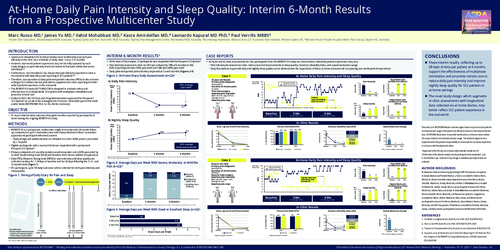
- Daily PROs (Numeric Rating Scale [NRS] for pain intensity and sleep quality) are collected via diary for 7-14 days at baseline and for 28 days following the 3-, 6-, and 12-month visits (Figure 1)
- Per participant, up to 98 daily outcomes will be collected for both pain intensity and sleep quality
INTERIM 6-MONTH RESULTS†
- At the time of this analysis, 31 participants were implanted with the Prospera SCS System*
- Pain intensity assessed in-clinic via VAS was reduced by 74% at 6 months (n=28); 82% of participants had ≥50% pain relief and 54% had ≥80% pain relief
- Daily patient-reported pain and sleep improved at 3 and 6 months (Figures 2-4)
CASE REPORTS
- At-home and in-clinic assessments for two participants from the BENEFIT-03 study are shown below; individual patient experiences may vary
- Pain intensity decreased over time, with concurrent improvements in sleep quality, Oswestry Disability Index, and opioid medication usage
- Daily fluctuations in pain intensity and nightly sleep quality scores demonstrate the importance of these at-home assessments in capturing real-world patient experiences
CONCLUSIONS
- These interim results, reflecting up to 28 days of data per patient at 6 months, support the effectiveness of multiphase stimulation and proactive remote care to reduce daily pain intensity and improve nightly sleep quality for SCS patients in at-home settings
- The novel study design, which augments in-clinic assessments with longitudinal data collected via at-home diaries, may better reflect SCS patient experience in the real world
Proactive Care: BIOTRONIK Neuro’s remote support team may reach out to patients to ensure proper usage of the spinal cord stimulator based on remotely monitored data. BIOTRONIK Neuro does not provide health advice or clinical actions outside the scope of spinal cord stimulator proper usage. This product support is not a replacement for the patient’s responsibility to communicate any medical questions or concerns with the physician’s office.
*Approved in the US only; not commercially available outside the US.
†At the time of this interim analysis not all participants had completed 3- and 6-month follow-ups. Outcomes may change as additional participant data are collected.
AUTHOR DISCLOSURES
M. Russo has historical minor equity holding in SPR Therapeutics and options in Saluda Medical and Presidio Medical. J. Yu has consulted for Abbott, Nevro, Medtronic, Boston Scientific and participated in research for Nevro, Boston Scientific, Medtronic, Saluda, Biotronik, and Nalu. V. Mohabbati has consulted for Medtronic, Abbott, Saluda, Nevro, and participated in research for Nevro, Medtronic, Abbott, Nalu, and Saluda. K. Amirdelfan has consulted for Medtronic, Boston Scientific, Nevro, Biotronik, and Nalu (minor options). L. Kapural has consulted for Nevro, Abbott, Medtronic, Nalu, Saluda, and Biotronik and participated in research for Nevro, Medtronic, Gimer Medical, Neuros, Saluda, Biotronik, and SPR Therapeutics. P. Verrills has consulted for Presidio, Biotronik, Saluda, and Nalu and has participated in research with Biotronik and Presidio.
REFERENCES
1. Schneider S, Junghaenel DU, Keefe FJ, et al. Pain. 2012;153(4):813-822.
2. Mun CJ, Suk HW, Davis MC, et al. Pain. 2019;160(11):2415-2429.
3. Thomson S, Tavakkolizadeh M, Love-Jones S, et al. Neuromod. 2018;21(1):67-76.
4. Kapural L, et al. At-Home Versus In-Clinic Pain Reporting for SCS Patients: Post Hoc Analysis of the BENEFIT-02 Study [NANS abstract 214538]. Neuromod. 2023;26(4):S66
This study is sponsored by BIOTRONIK • Writing and editorial assistance were provided by Prescott Medical Communications Group (Chicago, IL), a contractor of BIOTRONIK NRO, INC.
Presented at the American Society of Regional Anesthesia 22nd Annual Pain Medicine Meeting • November 10–11, 2023 • New Orleans, LA