425 posters, 1 videos, 9 audios, 8 topics, 53 sessions, 340 authors, 286 institutions
ePostersLive by SciGen Technologies S.A. All rights reserved.
22nd Annual Pain Medicine Meeting 2023
November 10 - 11, 2023 | New Orleans Marriott | New Orleans, Louisiana, USA

4987
BLOCKADE OF THE AURICULAR BRANCH OF THE VAGUS NERVE (ARNOLD’S NERVE) FOR CHRONIC OTALGIA
Poster Presenter
Authors
Affiliations
Part of Topic
Chronic Pain
TITLE:
Blockade of the Auricular Branch of the Vagus Nerve (Arnold’s Nerve) for Chronic Otalgia
AUTHOR DETAILS:
Daniel Kim, MD, MBA, daniel.kim2@med.usc.edu, primary author
Porus Mistry, MD, porus.mistry@med.usc.edu, co-author
Yasuko Mano, BS, ymano@usc.edu, 203-564-6765, co-author, presenting author
Michael Bottros, MD, michael.bottros@med.usc.edu, co-author
INTRODUCTION:
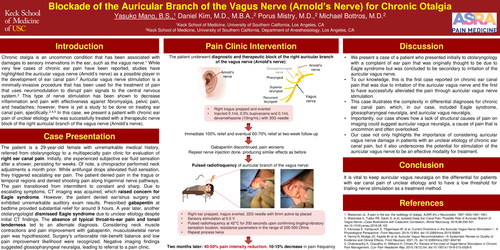
Chronic otalgia is an uncommon condition that has been associated with damages to sensory innervations in the ear, such as the vagus nerve (Cranial Nerve X).1 While very few cases of chronic ear pain have been reported, studies have highlighted the auricular vagus nerve (also known as Arnold’s nerve) as a possible player in the development of ear canal pain.2 Given that the auricular vagus nerve provides afferent sensory innervation to the ear canal, there is potential for the nerve to be targeted by nerve stimulation for the treatment of otalgia. Auricular vagus nerve stimulation is a minimally-invasive procedure that has been used for the treatment of pain that uses neuromodulation to disrupt pain signals to the central nervous system.3 This type of nerve stimulation has been shown to decrease inflammation and pathological pain, with effectiveness against fibromyalgia, pelvic pain, and headaches; however, there is yet a study to be done on treating ear canal pain, specifically.3,4,5 In this case, we present a patient with chronic ear pain of unclear etiology who was successfully treated with a therapeutic nerve block of the right auricular branch of the vagus nerve (Arnold’s nerve).
MATERIALS AND METHODS:
As the case report is devoid of patient identifiable information, it is exempt from IRB review requirements as per Keck Medicine of USC policy.
RESULTS/CASE REPORT:
We present the case of a 29-year-old female with unremarkable medical history, referred from otolaryngology to a multispecialty pain clinic for evaluation of right ear canal pain. Initially, she experienced subjective ear fluid sensation after a shower, persisting for weeks. Of note, a chiropractor performed neck adjustments a month prior. While antifungal drops alleviated fluid sensation, they triggered escalating ear pain. Ear exam was normal, but the pain intensified. The patient denied pain in tragus or temporal regions and shooting pain along trigeminal nerve pathways. Pain transitioned from intermittent to constant and sharp. Due to escalating symptoms, CT imaging was acquired which raised concern for Eagle syndrome. Despite the history, the patient denied ear/sinus surgery and exhibited unremarkable auditory exam results. Prescribed gabapentin at bedtime provided substantial relief for around 9 hours. A year later, another otolaryngologist dismissed Eagle syndrome due to unclear etiology despite initial CT findings. The absence of typical throat-to-ear pain and tonsil tenderness led to an alternate diagnosis. Considering neck muscle contractions and pain improvement with gabapentin, musculoskeletal nerve pain was hypothesized. Surgery's unfavorable risk-benefit balance and low pain improvement likelihood were recognized. Negative imaging findings suggested glossopharyngeal neuralgia, leading to referral to a pain clinic.
The patient underwent diagnostic and therapeutic block of the right auricular branch of the vagus nerve (Arnold's nerve) for ear canal pain. The right tragus was prepped, everted, and a 30G needle inserted, injecting a solution of 0.1mL 0.5% bupivacaine and 0.1mL dexamethasone (10mg/mL). Post-block, the patient reported immediate 100% relief in her pain diary and eventual 60-70% relief at the 2-week follow-up. The patient was unsure if the pain relief stemmed from the injection or the recent initiation of gabapentin. So after the gabapentin was gradually discontinued and pain subsequently increased, patient underwent a repeat nerve injection, which again provided 100% relief the first 8 hours and 60-70% relief for 2 weeks. After about a week, the patient underwent pulsed radiofrequency of the auricular branch of the vagus nerve. The right ear was prepped, tragus everted, and a 22G needle with 5mm active tip placed. After sensory stimulation at 0.5V, pulsed radiofrequency at 42°C was administered for 200 seconds upon confirming tingling/vibratory sensation location, with resistance parameters in terms of impedance in the range of 200-500 Ohms. Rotation by 120 degrees repeated the process twice before needle removal. Two months later during a follow-up visit, the patient reported continued 40-50% pain intensity reduction and 10-15% decrease in pain frequency.
DISCUSSION:
We present a case of a 29-year-old female who presented initially to otolaryngology with a complaint of ear pain that was originally thought to be due to Eagle syndrome but was eventually concluded to be likely secondary to irritation of the auricular vagus nerve. To our knowledge, this is the first case reported on chronic ear canal pain that was due to irritation of the auricular vagus nerve. It is also the first case to have successfully alleviated the pain by conducting an auricular vagus nerve stimulation, which previously had been shown to be effective in treating pain in other parts of the body. Our case not only highlights the importance of considering auricular vagus nerve damage in patients with an unclear etiology of chronic ear canal pain, but it also underscores the potential for stimulation of the auricular vagus nerve to be an effective modality for treatment.
This case illustrates the complexity in differential diagnoses for chronic ear canal pain, which, in our case, included Eagle syndrome, glossopharyngeal neuralgia, and auricular vagus neuralgia. Our case demonstrates how this differential could be narrowed by assessing for improvement with medications that treat neuropathic pain, such as gabapentin. More importantly, it shows how a lack of structural causes of pain on imaging could suggest auricular vagus neuralgia, a cause of pain that is uncommon and often overlooked. It is vital to keep auricular vagus neuralgia on the differential for patients with ear canal pain of unclear etiology and to have a low threshold for trialing nerve stimulation as a treatment method.
REFERENCES:
1. Weissman JL. A pain in the ear: the radiology of otalgia. AJNR Am J Neuroradiol. 1997;18(9):1641-1651.
2. Watanabe K, Tubbs RS, Satoh S, et al. Isolated Deep Ear Canal Pain: Possible Role of Auricular Branch of Vagus Nerve—Case Illustrations with Cadaveric Correlation. World Neurosurg. 2016;96:293-301. doi:10.1016/j.wneu.2016.08.102
3. Kaniusas E, Kampusch S, Tittgemeyer M, et al. Current Directions in the Auricular Vagus Nerve Stimulation I - A Physiological Perspective. Front Neurosci. 2019;13:854. doi:10.3389/fnins.2019.00854
4. Verma N, Mudge JD, Kasole M, et al. Auricular Vagus Neuromodulation—A Systematic Review on Quality of Evidence and Clinical Effects. Front Neurosci. 2021;15. doi:10.3389/fnins.2021.664740
5. Chakravarthy K, Chaudhry H, Williams K, Christo PJ. Review of the Uses of Vagal Nerve Stimulation in Chronic Pain Management. Curr Pain Headache Rep. 2015;19(12):54. doi:10.1007/s11916-015-0528-6