425 posters, 1 videos, 9 audios, 8 topics, 53 sessions, 340 authors, 286 institutions
ePostersLive by SciGen Technologies S.A. All rights reserved.
22nd Annual Pain Medicine Meeting 2023
November 10 - 11, 2023 | New Orleans Marriott | New Orleans, Louisiana, USA

4955
ANALYSIS OF THE CASE REPORTS OF SPINAL HEMATOMA AFTER INTERVENTIONAL PAIN PROCEDURES IN PATIENTS ON AND WITHOUT ANTICOAGULANTS
Poster Presenter
Authors
Affiliations
Part of Topic
Chronic Pain
Analysis of the Case Reports of Spinal Hematoma After Interventional Pain Procedures in Patients on and Without Anticoagulants
AUTHOR(S):
Honorio T. Benzon, MD,1, Ariana M. Nelson, MD,2 Arpan G. Patel, MD,1 Silvia Chiang, MD,2 Deepti Agarwal, MD,1 Hubert A. Benzon, MD,1 Robert J. McCarthy, Pharm.D3
1Anesthesiology, Northwestern University Feinberg School of Medicine, Chicago, IL, USA, 2Anesthesiology, University of California at Irvine, Irvine, CA, USA, 3Anesthesiology, Rush University Medical School, Wheaton, IL, USA.
ABSTRACT:
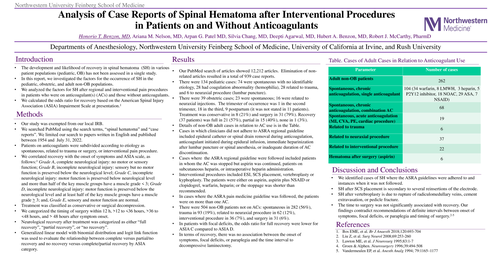
Introduction: A study that looked at case reports of spinal hematoma (SH) showed that neurologic recovery was related to the baseline American Spinal Injury Association (ASIA) Impairment scale (1), and not on the interval between surgery and the onset of symptoms, the onset of focal deficit, or the onset of paralysis. In this report, we examined the likelihood of recovery based on ASIA impairment scale and time to surgical decompression. We analyzed the factors for the occurrence of SH after regional and interventional pain procedures in patients who were on anticoagulant(s) and those who were not anticoagulants. In patients on anticoagulants, we determined whether the authors followed the ASRA recommendations on regional anesthesia or interventional pain procedures.
Methods: As our study is devoid of patient identifiable information, it is exempt from IRB review requirements as per Northwestern University Feinberg School of Medicine policy. We searched PubMed using the search terms “spinal hematoma” and “case reports”. We limited our search to publications with English abstracts published between 1954 (the first case report of spinal hematoma listed in PubMed) and July 31, 2022. The patients on anticoagulants were further subdivided according to etiology as spontaneous, related to trauma or surgery, or to neuraxial intervention. An outcome was the reported recovery of patients following a SEH. The primary variables of interest were the presenting ASIA score, conservative vs. surgical management, and timing of surgery. The primary analysis examined complete versus partial/no recovery and no recovery versus complete/partial recovery by ASIA category using a generalized linear model with a binomial distribution and a logit link function. A second analysis was performed on subjects that received conservative treatment only. Odds ratios and 95% confidence intervals were calculated as measures of effect. An additional analysis was performed on subjects that had surgical treatment examining the timing of surgery in relation to the event as well as the ASIA score. In this analysis, time from event, ASIA score, and the interaction of time to event and ASIA score were evaluated. A P<0.05 was required to reject the null hypothesis. Statistical analysis was performed using RStudio version 2023.06.1 release date 7 July 2023 (Posit Software, PBC, Boston, Massachusetts, USA; URL: http://www.posix.com/) and R version 4.3.1, release date 16 June 2023 (The R Foundation for Statistical Computing, Vienna, Austria).
Results: There were a total of 939 case reports of spinal hematoma: 134 pediatric cases, 39 obstetric cases, 262 adult non-obstetric cases on anticoagulant therapy, and 504 adult patients not on anticoagulants (table). Of the 262 patients who were on chronic anticoagulant therapy, 172 (104 on single anticoagulant, 68 on combination anticoagulants) were spontaneous. An additional 19 patients had spontaneous hematoma during acute anticoagulation for acute MI, stroke, or pulmonary embolism. The patients in whom the ASRA guidelines were not followed included those who had their epidural catheter or spinal drain removed while on an anticoagulant; an anticoagulant was started while the patient was on epidural infusion; heparinization after a lumbar puncture or spinal anesthesia; or inadequate discontinuation of the anticoagulant before surgery. The cases where the ASRA guidelines were followed included patients where the anticoagulant was stopped but the aspirin continued; patients on subcutaneous heparin; IV heparin was given intraoperatively after the anticoagulants were stopped or when the aspirin was continued; or multiple attempts of neuraxial placement. In the patients who were not on anticoagulants, most of the 62 spinal or epidural placements required one to two attempts, with no technical difficulty noted. In one patient, the hematoma developed after removal of an epidural catheter in a patient who was not on anticoagulant. Neurologic recovery was related to the ASIA impairment scale and not to the interval between onset of symptoms and timing of surgery (261 patients with definite data) or to the interval between onset of paralysis and timing of surgery (135 patients with definite data).
Discussion and conclusion: Our data showed a preponderance of spontaneous SH whether the patient was on anticoagulant or not. Many cases involved patients on multiple anticoagulants, even when the ASRA guidelines were followed, an observation that was noted previously (2). This may be due to the lingering effect of the (appropriately) discontinued anticoagulant magnifying the action of the antithrombotic that was continued or given just before or during surgery. Prophylactic-range anticoagulant activity, evidenced by plasma anti-Xa levels, has been demonstrated 24 hours after the last dose of low-molecular weight heparin (3). Upcoming guidelines should address these scenarios. Hematomas after spinal cord stimulator placements were likely secondary to the several reinsertions of the electrodes in a patient with stenosis or scarring from laminectomy, or to the laminectomy required in placing the paddle electrodes. Hematomas after vertebroplasty has been ascribed to venous congestion of the vertebral venous plexus leading to rupture of the radiculomedullary veins into the subdural space, cement extravasation to the spinal canal (4) or to fracture in the pedicle after kyphoplasty (5). Development of spinal hematoma after intrathecal pump placement is similar to neuraxial catheter placements. Recovery is related more to the patient’s neurologic status and not on the interval between initial symptoms or paraplegia and surgery.
References: 1. Liu et al. Surg Neurol 2008;69:253-260. 2. Kubulus et al. Reg Anesth Pain Med 2022;47:653-659. 3. Knoerlein J, et al. Reg Anesth Pain Med 2023;48:211-216. 4. Tropeano MP, et al. World J Clin Cases 2017;16:333-339. 5. Nogami R, et al. J Spine Surg 2022;8:491-496.