425 posters, 1 videos, 9 audios, 8 topics, 53 sessions, 340 authors, 286 institutions
ePostersLive by SciGen Technologies S.A. All rights reserved.
22nd Annual Pain Medicine Meeting 2023
November 10 - 11, 2023 | New Orleans Marriott | New Orleans, Louisiana, USA

4806
COMPARISON OF TEMPERATURE CHANGES FOLLOWING SYMPATHETIC BLOCKS IN WARM AND COLD SUBTYPES OF COMPLEX REGIONAL PAIN SYNDROME
Poster Presenter
Authors
Affiliations
Part of Topic
Chronic Pain
Comparison of Temperature Changes Following Sympathetic Blocks in Warm and Cold Subtypes of Complex Regional Pain Syndrome
Burcu Candan, Semih Gungor
Hospital for Special Surgery
Introduction
Skin temperature asymmetry between the affected and unaffected limbs is common in Complex Regional Pain Syndrome (CRPS). The warm or cold subtypes of CRPS have been defined depending on the temperature of the affected limb at the time of diagnosis. Warm CRPS is more frequently encountered in the acute and early phases of the CRPS, the pathophysiology of which is attributed to the increased inflammatory response. On the other hand, the cold CRPS subtype is more common in the chronic and late stages of CRPS, attributed to increased sympathetic activity, vasoconstriction, and decreased blood flow. Due to the different mechanisms involved in the warm and cold CRPS subtypes, we hypothesize that each subtype's response to the sympathetic block will differ. We evaluated whether there is a difference in temperature elevation following sympathetic blocks in patients with warm and cold CRPS subtypes and whether the temperature elevation is considerably higher in the cold CRPS subtype following the sympathetic block.
Materials and Methods
This retrospective cohort study was approved by the Institutional Review Board (2023-1555). This study includes patients who meet the Budapest criteria for diagnosis of CRPS of the lower extremity within the study date and who presented for lumbar sympathetic blocks (LSB). We retrospectively analyzed the preoperative FLIR images obtained by the thermal camera in 90 consecutive lumbar sympathetic blocks performed on 34 CRPS patients from January 1st to July 31st, 2023. We analyzed the results in two groups, including “initial” for 34 CRPS patients and “all” for all 90 consecutive LSB procedures.
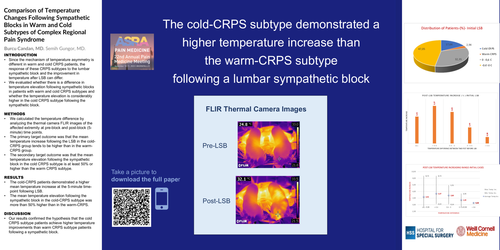
We performed the LSB procedure in eligible patients diagnosed with CRPS refractory to conservative therapy. We monitored the FLIR images with a thermal camera in the lower extremities of CRPS patients throughout the LSB procedure to determine whether effective sympathetic blocks were achieved. In this retrospective study, we calculated the temperature difference by analyzing the thermal camera FLIR images of the affected extremity at pre-block and post-block (5-minute) time points.
Based on the existing literature, the clinically meaningful temperature difference between the extremities of the patients with CRPS is > 0.6°C [1]. Therefore, we defined the warm or cold CRPS subtypes if there was > 0.6°C difference between the lower extremities at the pre-block time point. If the temperature difference was <0.6°C, we accepted it as a physiological normal variation.
Our hypothesis and the primary outcome were that the mean temperature increase following the LSB in the cold-CRPS group would be higher than in the warm-CRPS group. The secondary outcome was that the mean temperature elevation following the sympathetic block in the cold CRPS subtype is at least 50% or higher than the warm CRPS subtype.
Results/Case Report
The primary and secondary outcomes were satisfied after the analysis of our data. The cold-CRPS patients achieved higher mean temperature increase at the 5-minute time-point following LSB with an average of 3.37°C and 2.67°C for initial and all cases, respectively. The temperature increase in warm-CRPS patients was lower than that of cold-CRPS patients, with a mean increase of 0.58°C and 1.23°C for initial and all cases, respectively. The mean temperature elevation following the sympathetic block in the cold-CRPS subtype was more than 50% higher than in the warm-CRPS subtype achieving the secondary outcome. The highest temperature difference that occurred was seen in one patient with 10.99°C. Our data in all 90 cases showed that the temperature changes in the affected extremity following LSB could vary between -1.32°C and 10.99°C.
Discussion
The abnormalities in peripheral vascular function in early warm-CRPS are explained by the disappearance of vasoconstrictor reflexes originating from the central nervous system and by neurogenic inflammation caused by peripheral mechanisms [2,3]. The warm CRPS largely (75-80%) resolves within 6 to 13 months of symptom onset, at least in patients receiving active therapy [4]. Approximately 20% of CRPS patients can turn into the chronic-cold stage, which may result in chronic pain and disability [2]. As opposed to the acute phase, in the chronic phase, vasoconstriction is dominant in the affected limb [5].
Since the mechanism of temperature asymmetry is entirely different in warm and cold CRPS patients, the response of these CRPS subtypes to the lumbar sympathetic block and the improvement in temperature after LSB can differ. Therefore, the temperature elevation following a sympathetic block is expected to be considerably higher in the affected cold limb due to vasoconstriction than in the warm CRPS subtype.
Our results confirmed the hypothesis that the cold CRPS subtype patients achieved higher temperature improvement than warm CRPS subtype patients following sympathetic block. We believe this study's result may redefine and update the definition of a successful sympathetic block depending on the warm or cold subtypes in CRPS.
References
1. Bruehl S, Lubenow TR, Nath H, Ivankovich O. Validation of thermography in the diagnosis of reflexsympathetic dystrophy. Clin J Pain. 1996 Dec;12(4):316-25. doi: 10.1097/00002508-199612000-00011. PMID: 8969877.
2. Wasner, G., Heckmann, K., Maier, C., & Baron, R. (1999). Vascular abnormalities in acute reflexsympathetic dystrophy (CRPS I): complete inhibition of sympathetic nerve activity with recovery. Archives of neurology, 56(5), 613–620. https://doi.org/10.1001/archneur.56.5.613
3. Wasner G. (2010). Vasomotor disturbances in complex regional pain syndrome--a review. Pain medicine (Malden, Mass.), 11(8), 1267–1273. https://doi.org/10.1111/j.1526-4637.2010.00914.x
4. Bean DJ, Johnson MH, Kydd RR. The outcome of complex regional pain syndrome type 1: a systematic review. J Pain. 2014 Jul;15(7):677-90. doi: 10.1016/j.jpain.2014.01.500. Epub 2014 Feb 12. PMID: 24530407.
5. Wasner, G., Schattschneider, J., Heckmann, K., Maier, C., & Baron, R. (2001). Vascular abnormalitiesin reflex sympathetic dystrophy (CRPS I): mechanisms and diagnostic value. Brain: a journal of neurology, 124(Pt 3), 587–599. https://doi.org/10.1093/brain/124.3.587