425 posters, 1 videos, 9 audios, 8 topics, 53 sessions, 340 authors, 286 institutions
ePostersLive by SciGen Technologies S.A. All rights reserved.
22nd Annual Pain Medicine Meeting 2023
November 10 - 11, 2023 | New Orleans Marriott | New Orleans, Louisiana, USA

4803
A SYSTEMATIC REVIEW OF INTRATHECAL INFLAMMATORY MASS AND CATHETER ADHESION IN PATIENTS WITH INTRATHECAL DRUG DELIVERY SYSTEMS
Poster Presenter
Authors
Affiliations
Part of Topic
Chronic Pain
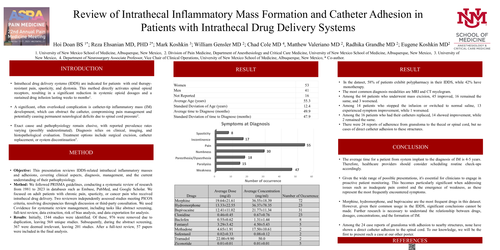
Review of Intrathecal Inflammatory Mass Formation and Catheter Adhesion in Patients with Intrathecal Drug Delivery Systems
Hoi Doan BS1*; Reza EhsanianMD, PHD 2*; Mark Koshkin 3; William Gensler MD 2; Chad Cole MD 4, Matthew Valeriano MD 2, Radhika Grandhe MD 2; Eugene Koshkin MD2
Intrathecal drug delivery systems (IDDS) are indicated for patients with oral therapy-resistant pain, spasticity, and dystonia. This method directly activates spinal opioid receptors, resulting in a significant reduction in systemic opioid dosages and a sustained drug infusion lasting weeks to months1.
•
A significant, often overlooked complication is catheter-tip inflammatory mass (IM) development, which can obstruct the catheter, compromising pain management and potentially causing permanent neurological deficits due to spinal cord pressure2.
•
Exact cause and pathophysiology remain elusive, with reported prevalence rates varying (possibly underestimated). Diagnosis relies on clinical, imaging, and histopathological evaluation. Treatment options include
Objective:ThispresentationreviewsIDDS-relatedintrathecal inflammatorymassesandadhesions,coveringclinicalaspects, diagnosis,management,andthecurrentunderstandingoftheir pathophysiology. •Method:WefollowedPRISMAguidelines,conductinga systematicreviewofresearchfrom1981to2023indatabases suchasEmbase,PubMed,andGoogleScholar.Wefocusedon adultpatientswithchronicpain,spasticity,orcancerpainwho receivedintrathecaldrugdelivery.Tworeviewers independentlyassessedstudiesmeetingPICOScriteria, resolvingdiscrepanciesthroughdiscussionorthird-party consultation.WeusedCovidenceforsystematicreview management,includingtaskslikeabstractscreening,full-text review,dataextraction,riskofbiasanalysis,anddata exportationforanalysis. •Results:Initially,1544studieswereidentified.Ofthese,976 wereremovedduetoduplication,leaving568uniquestudies. Subsequently,duringtheabstractscreening,367weredeemed irrelevant,leaving201studies.Afterafull-textreview,57 paperswereincludedinthefinalanalysis.
Inthedataset,58%ofpatientsexhibitpolypharmacyintheir IDDS,while42%havemonotherapy. • ThemostcommondiagnosismodalitiesareMRIandCT myelogram. •Amongthe64patientswhounderwentmassexcision,45 improved,16remainedstable,and3worsened. •Among14patientswhostoppedtheinfusionorswitchedto normalsaline,13experiencedsymptomimprovement,while 1worsened. •Amongthe16patientswhohadtheircathetersreplaced,14 showedimprovement,while2remainedthesame. • Therewere24reportsofadherencefromgranulomatothe thecalorspinalcord,butnocasesofdirectcatheteradhesion tothesestructures.
Theaveragetimeforapatientfromsystemimplanttothe diagnosisofIMis4-5years.Therefore,healthcareproviders shouldconsiderschedulingroutinecheck-upsaccordingly. •Giventhewiderangeofpossiblepresentations,it'sessential forclinicianstoengageinproactivepatientmonitoring.This becomesparticularlysignificantwhenaddressingissuessuch asinadequatepaincontrolandtheemergenceofweakness,as theserepresentthemostfrequentlyencounteredsymptoms. •Morphine,hydromorphone,andbupivacainearethemost frequentdrugsinthisdataset.However,giventheircommon usageintheIDDS,significantconclusionscannotbemade. Furtherresearchisnecessarytounderstandtherelationship betweendrugs,dosages,concentrations,andtheformationof IM. •Amongthe24casereportsofgranulomawithadhesionto nearbystructures,nonehaveshownadirectcatheteradhesion tothespinalcord.Toourknowledge,wewillbethefirstto presentsuchacaseatourotherposter.