425 posters, 1 videos, 9 audios, 8 topics, 53 sessions, 340 authors, 286 institutions
ePostersLive by SciGen Technologies S.A. All rights reserved.
22nd Annual Pain Medicine Meeting 2023
November 10 - 11, 2023 | New Orleans Marriott | New Orleans, Louisiana, USA

4642
DRAMATIC RELIEF OF NECK AND TRAPEZIUS PAIN FROM PERSISTENT SCAPULAR PROTRACTION FOLLOWING BOTOX TO PECTORALIS MINOR: A CASE REPORT
Poster Presenter
Authors
Affiliations
Part of Topic
Chronic Pain
Dramatic relief of neck and trapezius pain from persistent scapular protraction following Botox to pectoralis minor: A case report
Esha Jain, MD1, Soo Kim, MD1
1Mount Sinai Department of Rehabilitation and Human Performance
INTRODUCTION
-
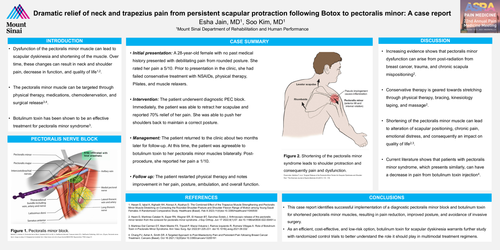
Dysfunction of the pectoralis minor muscle can lead to scapular dyskinesia and shortening of the muscle. Over time, these changes can result in neck and shoulder pain, decrease in function, and quality of life1,2.
-
The pectoralis minor muscle can be targeted through physical therapy, medications, chemodenervation, and surgical release3,4.
-
Botulinum toxin has been shown to be an effective treatment for pectoralis minor syndrome3.
CASE SUMMARY
• Initial presentation: A 28-year-old female with no past medical history presented with debilitating pain from rounded posture. She rated her pain a 5/10. Prior to presentation in the clinic, she had failed conservative treatment with NSAIDs, physical therapy, Pilates, and muscle relaxers.
• Intervention: The patient underwent diagnostic PEC block. Immediately, the patient was able to retract her scapulae and reported 70% relief of her pain. She was able to push her shoulders back to maintain a correct posture.
• Management: The patient returned to the clinic about two months later for follow-up. At this time, the patient was agreeable to botulinum toxin to her pectoralis minor muscles bilaterally. Post- procedure, she reported her pain a 1/10.
• Follow up: The patient restarted physical therapy and notes improvement in her pain, posture, ambulation, and overall function.
DISCUSSION
-
Increasing evidence shows that pectoralis minor dysfunction can arise from post-radiation from breast cancer, trauma, and chronic scapula mispositioning2.
-
Conservative therapy is geared towards stretching through physical therapy, bracing, kinesiology taping, and massage2.
-
Shortening of the pectoralis minor muscle can lead to alteration of scapular positioning, chronic pain, emotional distress, and consequently an impact on quality of life2,3.
-
Current literature shows that patients with pectoralis minor syndrome, which presents similarly, can have a decrease in pain from botulinum toxin injection4.
CONCLUSIONS
• This case report identifies successful implementation of a diagnostic pectoralis minor block and botulinum toxin for shortened pectoralis minor muscles, resulting in pain reduction, improved posture, and avoidance of invasive surgery.
• As an efficient, cost-effective, and low-risk option, botulinum toxin for scapular dyskinesia warrants further study with randomized control trials to better understand the role it should play in multimodal treatment regimens.