425 posters, 1 videos, 9 audios, 8 topics, 53 sessions, 340 authors, 286 institutions
ePostersLive by SciGen Technologies S.A. All rights reserved.
22nd Annual Pain Medicine Meeting 2023
November 10 - 11, 2023 | New Orleans Marriott | New Orleans, Louisiana, USA

4889
RACIAL AND ETHNIC DIFFERENCES IN THE USAGE OF OPIOIDS TO TREAT CHRONIC PAIN
Poster Presenter
Authors
Affiliations
Part of Topic
Chronic Pain
Title: Racial and Ethnic Differences in the Usage of Opioids to Treat Chronic Pain
Introduction:
- Many factors contribute to the varying perceptions and expressions of pain across different racial groups.
- Numerous studies have found that Black and Hispanic patients report higher pain intensity than Caucasian patients, even after controlling for socioeconomic status and other health conditions.
- Black and Hispanic patients are less likely than Caucasian patients to be prescribed opioids for their chronic pain.
- These disparities underscore the importance of equitable access to effective pain interventions and the need for ongoing efforts to raise awareness about how implicit biases can impede the delivery of culturally competent, patient-centered care.
Objective: The purpose of this study was to highlight the disparities in the usage of opioids to treat chronic pain between various racial and ethnic groups.
Methods:
- After receiving IRB approval, we conducted a retrospective analysis of 1,272 chronic pain patients at the Chicago Anesthesia Pain Specialists Clinic. 672 of these patients were treated with opioids.
- Patients self-identified as non-Hispanic white (White), Hispanic, or Black.
- Patients were seen at least 4 times over a minimum of 6 months.
- Patients were asked to quantify their pain levels using the Numeric Pain Rating Scale (NRS) at each clinic visit.
- Morphine milligram equivalents (MME) given at the first and last clinic visits were calculated using MDCalc.
- The physician’s response to the patient’s pain (MME/P) was quantified by dividing the MME given at the visit by the corresponding NRS pain score.
- Mean NRS pain scores, MMEs administered, and MME/P were compared across the various racial/ethnic groups.
Results:
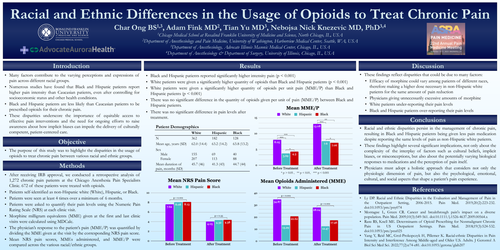
- Black and Hispanic patients reported significantly higher intensity pain (p < 0.001)
- White patients were given a significantly higher quantity of opioids than Black and Hispanic patients (p < 0.001)
- White patients were given a significantly higher quantity of opioids per unit pain (MME/P) than Black and Hispanic patients (p < 0.001)
- There was no significant difference in the quantity of opioids given per unit of pain (MME/P) between Black and Hispanic patients.
- There was no significant difference in pain levels after treatment.
Discussion:
Conclusion:
- Racial and ethnic disparities persist in the management of chronic pain, resulting in Black and Hispanic patients being given less pain medication despite reporting the same levels of pain as non-Hispanic white patients.
- These findings highlight several significant implications, not only about the complexity of the interplay of factors such as cultural beliefs, implicit biases, or misconceptions, but also about the potentially varying biological responses to medications and the perception of pain itself.
- Physicians must adopt a holistic approach that considers not only the physiologic dimension of pain, but also the psychological, emotional, cultural, and social aspects that shape a patient’s pain experience.