126 posters, 2 topics, 27 sessions, 324 authors, 82 institutions
ePostersLive by SciGen Technologies S.A. All rights reserved.
2025 ACP Annual Session
October 22 - 25, 2025 | New Orleans, US

31
Evaluating Temporomandibular Disorder symptoms and patterns through jaw motion tracking technology
Poster Presenter
Part of Topic
Evaluating Temporomandibular Disorder symptoms and patterns through
jaw motion tracking technology
Ariana Motamedi, Armin Jamshidi, Tariq Alsahafi BDS MS, Jane K. Rydin, Wendy A. Clark DDS MS
Adams School of Dentistry, University of North Carolina at Chapel Hill
OBJECTIVES
This study aimed to assess the accuracy of jaw motion
tracking (JMTK) technology in measuring maximum
opening (MO) and lateral excursion (LE) movements, and
to evaluate its reliability in detecting disc displacements.
INTRODUCTION
Understanding movements of the condyle is essential to
clinical practices of dentistry as deviations in condylar
trajectories can lead to Temporomandibular disorder (TMD)
symptoms including jaw pain.1 Healthy condylar movement
involves a fixed and stable trajectory, making it crucial to
understand and track in clinical settings, particularly in
complex rehabilitations.2 A definitive TMD diagnosis often
requires adjunctive diagnostic imaging including magnetic
resonance imaging (MRI) of the TMJ. However, the addition
of JMTK devices may aid in the early detection of disc
displacements.3 Previous methods of mandibular tracking included using
kinematic facebows and infrared cameras to track the
opening and closing patterns of the mandible and condyles.4-5
These studies showed that while healthy subjects displayed
the expected condylar trajectories, those with TMJ clicking
had deflections in their condylar paths at the point of the
click. Other studies conducted on current JMTK devices,
including Modjaw, showed how this technology can be used
alongside clinical examinations to increase the accuracy of
diagnosis and treatment.6-8
METHODS & MATERIALS
Twenty-one participants were recruited to participate in this study (UNC IRB 24-0296). Inclusion criteria included those with or
without TMJ pain and symptoms. A licensed Prosthodontist (WAC) performed a clinical exam on each participant. Measurements
for MO, deviations during MO, and LE movements were noted during the examination using a ROM scale ruler (Great Lakes
Orthodontics, Ltd).
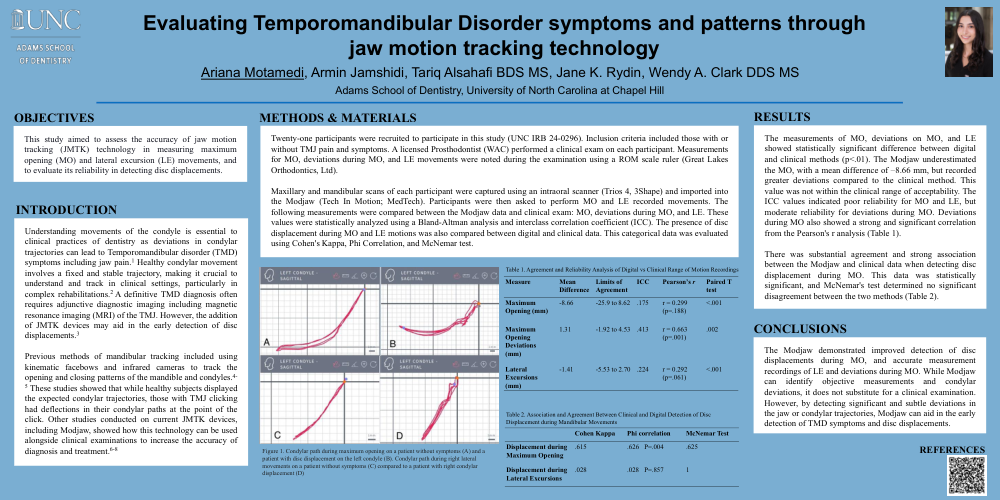
Maxillary and mandibular scans of each participant were captured using an intraoral scanner (Trios 4, 3Shape) and imported into
the Modjaw (Tech In Motion; MedTech). Participants were then asked to perform MO and LE recorded movements. The
following measurements were compared between the Modjaw data and clinical exam: MO, deviations during MO, and LE. These
values were statistically analyzed using a Bland-Altman analysis and interclass correlation coefficient (ICC). The presence of disc
displacement during MO and LE motions was also compared between digital and clinical data. This categorical data was evaluated
using Cohen's Kappa, Phi Correlation, and McNemar test.
RESULTS
The measurements of MO, deviations on MO, and LE
showed statistically significant difference between digital
and clinical methods (p<.01). The Modjaw underestimated
the MO, with a mean difference of –8.66 mm, but recorded
greater deviations compared to the clinical method. This
value was not within the clinical range of acceptability. The
ICC values indicated poor reliability for MO and LE, but
moderate reliability for deviations during MO. Deviations
during MO also showed a strong and significant correlation
from the Pearson's r analysis (Table 1).
There was substantial agreement and strong association
between the Modjaw and clinical data when detecting disc
displacement during MO. This data was statistically
significant, and McNemar's test determined no significant
disagreement between the two methods (Table 2).
CONCLUSIONS
The Modjaw demonstrated improved detection of disc
displacements during MO, and accurate measurement
recordings of LE and deviations during MO. While Modjaw
can identify objective measurements and condylar
deviations, it does not substitute for a clinical examination.
However, by detecting significant and subtle deviations in
the jaw or condylar trajectories, Modjaw can aid in the early
detection of TMD symptoms and disc displacements.