206 posters, 13 topics, 5 sessions, 713 authors, 293 institutions
ePostersLive by SciGen Technologies S.A. All rights reserved.
AAPS 104th Annual Meeting
May 2-5, 2026 | Lihue, HI

D21
Assessing Perioperative And Long-term Outcomes Of Delayed Cranial Vault Reconstruction In Nonsyndromic Craniosynostosis Patients
Poster Presenter
Authors
Affiliations
Part of Topic
Craniofacial/Peds
Introduction: Craniosynostosis is a congenital condition
characterized by premature fusion of one or more
cranial sutures, affecting approximately 5.9 per 10,000
live births worldwide and presenting as either
syndromic or nonsyndromic.1-3 Premature suture
fusion restricts normal skull growth and may result in
elevated intracranial pressure, disrupted brain
development, and progressive orbital abnormalities.4
Surgical correction is the mainstay of management,
with intervention commonly performed between 4–8
months of age.5, 8-10 However, national data
demonstrate that many children undergo surgery
beyond this window.11 Delayed surgery may increase
complications and adverse outcomes, but its long-
term effects remain unclear.
Purpose:
To evaluate the impact of delayed cranial vault
reconstruction (≥13 months) on perioperative,
neurodevelopmental, and ophthalmologic
outcomes in patients with nonsyndromic single-
suture craniosynostosis.
Methods:
Design:
• Retrospective cohort study (2014–2021) at a single
tertiary craniofacial center
Patients:
• Nonsyndromic single-suture craniosynostosis (NSCS)
• Underwent open cranial vault reconstruction (CVR)
• ≥1 year multidisciplinary follow-up (plastic surgery +
neurosurgery)
Statistical Analysis:
• t-test, Wilcoxon, Chi-square, Fisher’s exact
• Multivariable logistic and linear regression
• Significance: p < 0.05
• Software: R (v4.4.1)
Conclusion:
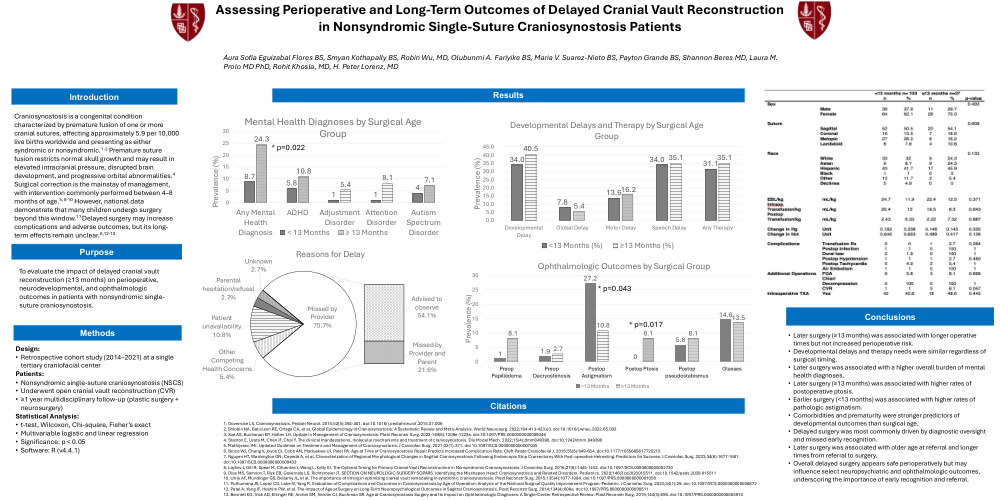
Later surgery (≥13 months) was associated with longer operative
times but not increased perioperative risk.
• Developmental delays and therapy needs were similar regardless of
surgical timing.
• Later surgery was associated with a higher overall burden of mental
health diagnoses.
• Later surgery (≥13 months) was associated with higher rates of
postoperative ptosis.
• Earlier surgery (<13 months) was associated with higher rates of
pathologic astigmatism.
• Comorbidities and prematurity were stronger predictors of
developmental outcomes than surgical age.
• Delayed surgery was most commonly driven by diagnostic oversight
and missed early recognition.
• Later surgery was associated with older age at referral and longer
times from referral to surgery.
• Overall delayed surgery appears safe perioperatively but may
influence select neuropsychiatric and ophthalmologic outcomes,
underscoring the importance of early recognition and referral.