206 posters, 13 topics, 5 sessions, 713 authors, 293 institutions
ePostersLive by SciGen Technologies S.A. All rights reserved.
AAPS 104th Annual Meeting
May 2-5, 2026 | Lihue, HI

D110
The Influence Of Social Determinants Of Health Across The Craniofacial Fracture Care Continuum: A Systematic Review
Poster Presenter
Part of Topic
Craniofacial/Peds
The Influence of Social Determinants of Health Across the Craniofacial Fracture Care Continuum: A Systematic Review
Kevin Vargas BS1, Sai Unnam BSBE1, Neeraj Suresh BS2, Anthony Shadid BA1, Philong Nguyen BS3, Joshua Wang BS3, Renata Maricevich MD1, Lucas A. Dvoracek MD1
1School of Medicine, Baylor College of Medicine, Houston, TX, 2Department of Anesthesiology, McGovern Medical School, 3School of Medicine, The University of Texas Medical Branch, Galveston, TX
INTRODUCTION
-
Social Determinants of Health (SDoH) are critical non-clinical drivers that fundamentally shape health disparities and patient outcomes across surgical specialties
-
While their influence is acknowledged, a comprehensive evaluation of how these factors impact the entire facial fracture care continuum, from initial injury risk to postoperative recovery, is necessary to identify systemic inequities
-
Understanding the cumulative effect of socioeconomic barriers is essential for developing targeted, evidence-based interventions that promote health equity in facial trauma care
-
This study addresses the need for a systematic synthesis of existing literature to delineate how SDoH creates a cycle of disadvantage for vulnerable patient populations
GOAL/HYPOTHESIS
-
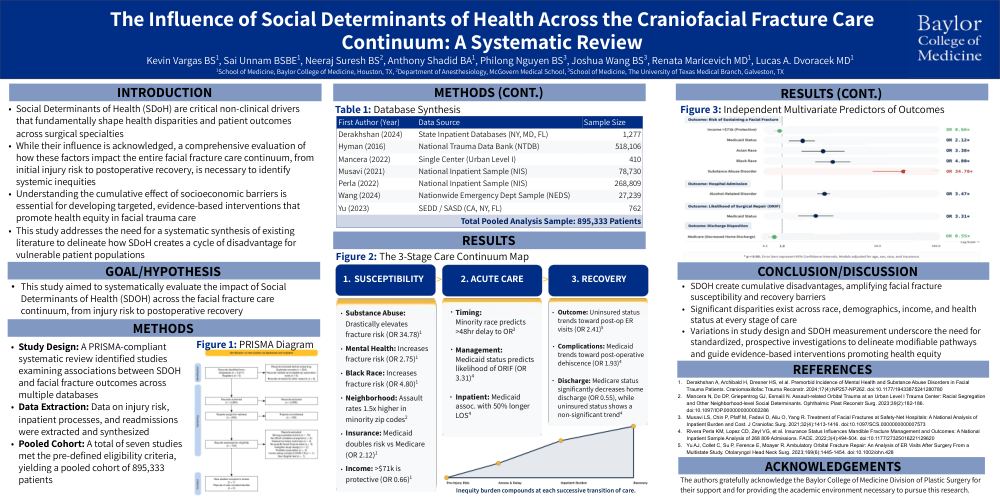
This study aimed to systematically evaluate the impact of Social Determinants of Health (SDOH) across the facial fracture care continuum, from injury risk to postoperative recovery
METHODS
-
Study Design: A PRISMA-compliant systematic review identified studies examining associations between SDOH and facial fracture outcomes across multiple databases
-
Data Extraction: Data on injury risk, inpatient processes, and readmissions were extracted and synthesized
-
Pooled Cohort: A total of seven studies met the pre-defined eligibility criteria, yielding a pooled cohort of 895,333 patients
Figure 1: PRISMA Diagram
METHODS (CONT.)
Table 1: Database Synthesis
|
First Author (Year) |
Data Source |
Sample Size |
|
Derakhshan (2024) |
State Inpatient Databases (NY, MD, FL) |
1,277 |
|
Hyman (2016) |
National Trauma Data Bank (NTDB) |
518,106 |
|
Mancera (2022) |
Single Center (Urban Level I) |
410 |
|
Musavi (2021) |
National Inpatient Sample (NIS) |
78,730 |
|
Perla (2022) |
National Inpatient Sample (NIS) |
268,809 |
|
Wang (2024) |
Nationwide Emergency Dept Sample (NEDS) |
27,239 |
|
Yu (2023) |
SEDD / SASD (CA, NY, FL) |
762 |
|
Total Pooled Analysis Sample: 895,333 Patients |
||
RESULTS
Figure 2: The 3-Stage Care Continuum Map
-
SUSCEPTIBILITY
Substance Abuse: Drastically elevates fracture risk (OR 34.78)1
Mental Health: Increases fracture risk (OR 2.75)1
Black Race: Increases fracture risk (OR 4.80)1
Neighborhood: Assault rates 3-5x higher in minority zip codes2
Insurance: Medicaid doubles risk vs Medicare (OR 2.12)1
Income: >$71k is protective (OR 0.66)1
2. ACUTE CARE
Timing: Minority race predicts >48hr delay to OR3
Management: Medicaid status predicts likelihood of ORIF (OR 3.31)4
Inpatient: Medicaid assoc. with 50% longer LOS4
3. RECOVERY
Outcome: Uninsured status trends toward post-op ER visits (OR 2.41)5
Complications: Medicaid trends toward post-operative dehiscence (OR 1.93)4
Discharge: Medicare/uninsured status decreases home discharge4
Inequity burden compounds at each successive transition of care.
RESULTS (CONT.)
Figure 3: Independent Multivariate Predictors of Outcome
CONCLUSION/DISCUSSION
-
SDOH create cumulative disadvantages, amplifying facial fracture susceptibility and recovery barriers
-
Significant disparities exist across race, demographics, income, and health status at every stage of care
-
Variations in study design and SDOH measurement underscore the need for standardized, prospective investigations to delineate modifiable pathways and guide evidence-based interventions promoting health equity
REFERENCES
-
Derakhshan A, Archibald H, Dresner HS, et al. Premorbid Incidence of Mental Health and Substance Abuse Disorders in Facial Trauma Patients. Craniomaxillofac Trauma Reconstr. 2024;17(4):NP257-NP262. doi:10.1177/19433875241280780
-
Mancera N, Do DP, Griepentrog GJ, Esmaili N. Assault-related Orbital Trauma at an Urban Level I Trauma Center: Racial Segregation and Other Neighborhood-level Social Determinants. Ophthalmic Plast Reconstr Surg. 2023;39(2):182-186. doi:10.1097/IOP.0000000000002286
-
Musavi LS, Chin P, Pfaff M, Fadavi D, Aliu O, Yang R. Treatment of Facial Fractures at Safety-Net Hospitals: A National Analysis of Inpatient Burden and Cost. J Craniofac Surg. 2021;32(4):1413-1416. doi:10.1097/SCS.0000000000007573
-
Rivera Perla KM, Lopez CD, Zeyl VG, et al. Insurance Status Influences Mandible Fracture Management and Outcomes: A National Inpatient Sample Analysis of 268 809 Admissions. FACE. 2022;3(4):494-504. doi:10.1177/27325016221129620
-
Yu AJ, Collet C, Su P, Ference E, Moayer R. Ambulatory Orbital Fracture Repair: An Analysis of ER Visits After Surgery From a Multistate Study. Otolaryngol Head Neck Surg. 2023;169(6):1445-1454. doi:10.1002/ohn.428
ACKNOWLEDGEMENTS
The authors gratefully acknowledge the Baylor College of Medicine Division of Plastic Surgery for their support and for providing the academic environment necessary to pursue this research.