206 posters, 13 topics, 5 sessions, 713 authors, 293 institutions
ePostersLive by SciGen Technologies S.A. All rights reserved.
AAPS 104th Annual Meeting
May 2-5, 2026 | Lihue, HI

D7
Longitudinal Changes In Intracranial Volume Following Sequential Strip Craniectomy And Posterior Vault Distraction In Syndromic Craniosynostosis
Poster Presenter
Part of Topic
Craniofacial/Peds
PURPOSE: Staged reconstruction is standard for syndromic bicoronal craniosynostosis, but the volumetric impact of combining early ESC with PVDO is unclear; we evaluated whether this sequence increases ICV during infancy.
METHODS: Syndromic bicoronal patients treated with ESC (1-3 months) and PVDO (6-8 months) between 2020-2025 were reviewed. CT-derived ICVs (VisAR, Novarad) were measured longitudinally at pre-ESC, post-ESC, pre-PVDO, and post-PVDO time points. Paired comparisons used Wilcoxon signed-rank testing (α = 0.05).
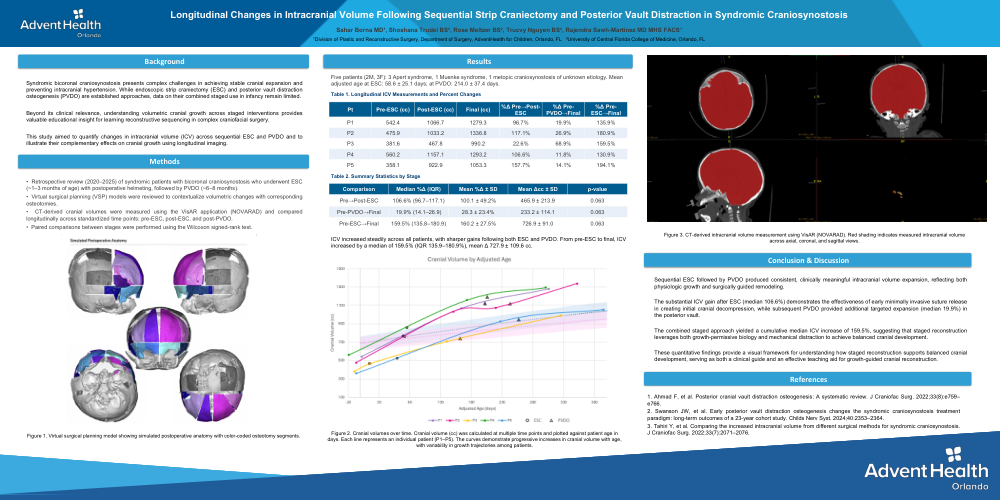
RESULTS: Five patients were included (60% female; three with Apert syndrome, one with Muenke syndrome, and one with unspecified genetic etiology). The mean adjusted age at ESC was 59 days and at PVDO was 214 days. Median ICV increased from 475.9 cc (interquartile range, 381.6-542.4) before ESC to 1,033.2 cc (922.9-1,066.7) after ESC, representing a 106.6% median increase. After PVDO, median ICV further increased to 1,279.3 cc (1,053.3-1,293.2), an additional 19.9% increase. Across the entire staged course, ICV increased by a median of 159.5% (interquartile range, 135.9-180.9%; p = 0.063).
CONCLUSION: Sequential ESC and PVDO produced substantial ICV gains, reflecting both surgical and physiologic growth. Despite a small sample, findings support this staged approach as a potential strategy for early ICV normalization in syndromic craniosynostosis.