206 posters, 13 topics, 5 sessions, 713 authors, 293 institutions
ePostersLive by SciGen Technologies S.A. All rights reserved.
AAPS 104th Annual Meeting
May 2-5, 2026 | Lihue, HI

PC55
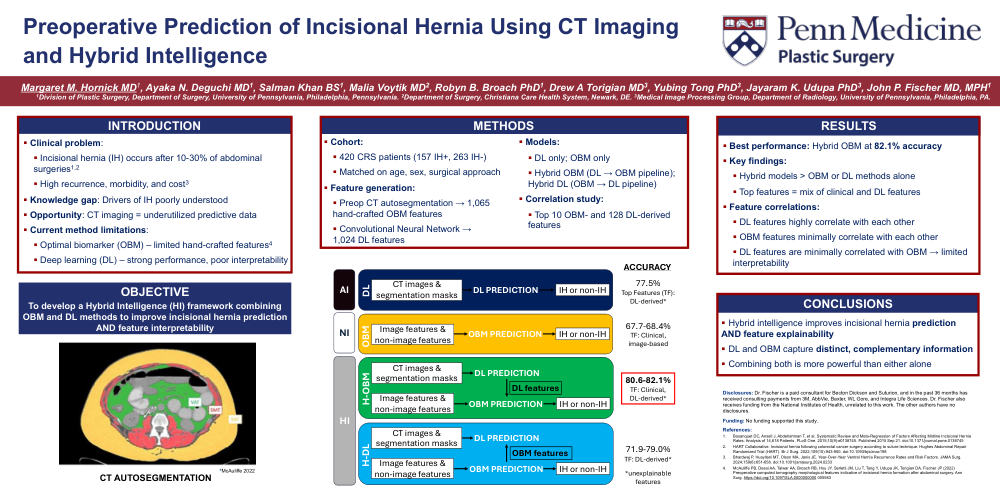
Preoperative Prediction Of Incisional Hernia Using Ct Imaging And Hybrid Intelligence Integrating Deep Learning And Optimal Biomarker Methods
Poster Presenter
Authors
Margaret Hornick, Ayaka Deguchi, Salman Khan, Malia Voytik, Robyn Broach, Drew Torigian, Yubing Tong, Jayaram Udupa, John Fischer
Affiliations
Division of Plastic Surgery, Department of Surgery, University of Pennsylvania, Division of Plastic Surgery, Department of Surgery, University of Pennsylvania, Philadelphia, PA., Department of Surgery, Christiana Care Health System, Newark, DE., Medical Imaging Processing Group, Department of Radiology, University of Pennsylvania, Philadelphia, PA.
Part of Topic
Technology and Innovation
Preoperative Prediction Of Incisional Hernia Using Ct Imaging And Hybrid Intelligence Integrating Deep Learning And Optimal Biomarker Methods
Margaret M. Hornick MD1, Ayaka N. Deguchi MD1, Salman Khan BS1, Malia Voytik MD2, Robyn B. Broach PhD1, Drew A Torigian MD3, Yubing Tong PhD3, Jayaram K. Udupa PhD3, John P. Fischer MD, MPH1
▪ 1Division of Plastic Surgery, Department of Surgery, University of Pennsylvania, Philadelphia, Pennsylvania.
▪ 2Department of Surgery, Christiana Care Health System, Newark, DE.
▪ 3Medical Image Processing Group, Department of Radiology, University of Pennsylvania, Philadelphia, PA.
INTRODUCTION
Clinical problem:
▪ Incisional hernia (IH) occurs after 10-30% of abdominal surgeries(1,2)
▪ High recurrence, morbidity, and cost(3)
Knowledge gap: Drivers of IH poorly understood
Opportunity: CT imaging = underutilized predictive data
Current method limitations:
▪ Optimal biomarker (OBM) – limited hand-crafted features(4)
▪ Deep learning (DL) – strong performance, poor interpretability
OBJECTIVE
To develop a Hybrid Intelligence (HI) framework combining OBM and DL methods to improve incisional hernia prediction AND feature interpretability
METHODS
Cohort:
▪ 420 CRS patients (157 IH+, 263 IH-)
▪ Matched on age, sex,surgical approach
Feature generation:
▪ Preop CT autosegmentation → 1,065 hand-crafted OBM features
▪ Convolutional Neural Network → 1,024 DL features
Models:
▪ DL only; OBM only; Hybrid OBM (DL → OBM pipeline); Hybrid DL (OBM → DL pipeline)
Correlation study:
▪ Top 10 OBM- and 128 DL-derived features
RESULTS
Best performance: Hybrid OBM at 82.1% accuracy
Key findings:
▪ Hybrid models > OBM or DL methods alone
▪ Top features = mix of clinical and DL features
Feature correlations:
▪ DL features highly correlate with each other
▪ OBM features minimally correlate with each other
▪ DL features are minimally correlated with OBM → limited interpretability
CONCLUSIONS
▪ Hybrid intelligence improves incisional hernia prediction AND feature explainability
▪ DL and OBM capture distinct, complementary information
▪ Combining bothis more powerful than either alone
Disclosures: Dr. Fischeris a paid consultant for Becton Dickson and Suturion, and in the past 36 months has received consulting payments from 3M, AbbVie, Baxter, WL Gore, and Integra Life Sciences. Dr. Fischer also receives funding from the National Institutes of Health, unrelated to this work. The other authors have no disclosures.
Funding: No funding supported this study.
References:
1. Bosanquet DC, Ansell J, Abdelrahman T, et al. Systematic Review and Meta-Regression of Factors Affecting Midline Incisional Hernia Rates: Analysis of 14,618 Patients.PLoS One. 2015;10(9):e0138745. Published 2015 Sep 21. doi:10.1371/journal.pone.0138745
2. HART Collaborative. Incisional hernia following colorectal cancer surgery according to suture technique: Hughes Abdominal Repair Randomized Trial (HART).Br J Surg. 2022;109(10):943-950. doi:10.1093/bjs/znac198
3. Bhardwaj P, Huayllani MT, Olson MA, Janis JE. Year-Over-Year Ventral Hernia Recurrence Rates and Risk Factors.JAMA Surg. 2024;159(6):651-658. doi:10.1001/jamasurg.2024.0233
4. McAuliffe PB, Desai AA, Talwar AA, Broach RB, Hsu JY, Serletti JM, Liu T, Tong Y, Udupa JK, Torigian DA, Fischer JP (2022) Preoperative computed tomography morphological features indicative of incisional hernia formation after abdominal surgery. Ann Surg. https://doi.org/10.1097/SLA.0000000000 005583