206 posters, 13 topics, 5 sessions, 713 authors, 293 institutions
ePostersLive by SciGen Technologies S.A. All rights reserved.
AAPS 104th Annual Meeting
May 2-5, 2026 | Lihue, HI

D65
Leveraging Artificial Intelligence To Assess Quality Of Life Via Facial And Vocal Analysis In Facial Transplantation Recipients
Poster Presenter
Authors
Neil Menghani, Claire Olivas, Paul Sheriff, Michael McKenna, Hailey Wyatt, Eduardo Rodriguez, Laura Kimberly
Affiliations
NYU Langone Health, Hansjörg Wyss Department of Plastic Surgery, NYU Grossman School of Medicine, New York, USA, Hansjörg Wyss Department of Plastic Surgery, NYU Grossman School of Medicine, New York, USA; Department of Population Health
Part of Topic
Technology and Innovation
Purpose
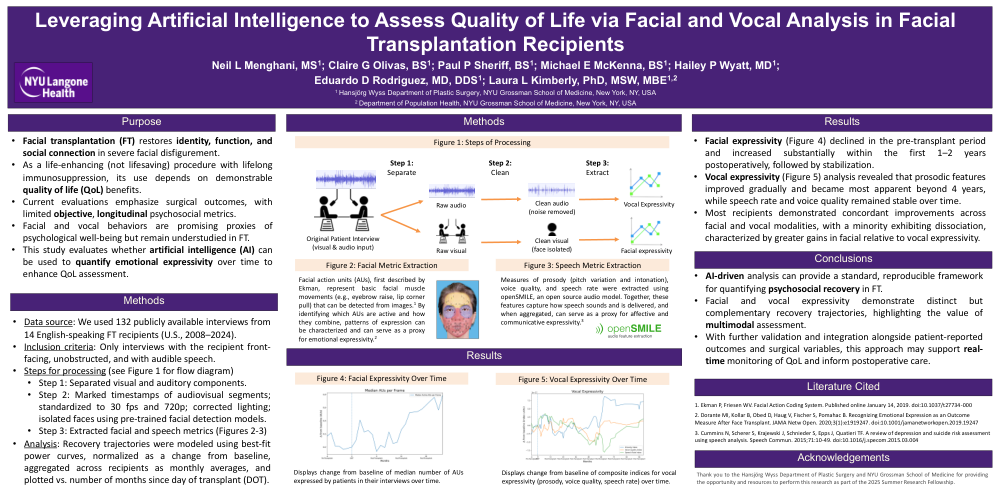
Facial transplantation (FT) restores identity, function, and social connection in patients with severe facial disfigurement. As a life-enhancing procedure requiring lifelong immunosuppression, its use depends on demonstrable improvements in quality of life (QoL). Current evaluations emphasize surgical outcomes, with limited objective, longitudinal psychosocial metrics. Facial and vocal behaviors represent promising proxies of emotional expressivity but remain understudied in FT. This study evaluates whether artificial intelligence (AI) can quantify changes in emotional expressivity over time to enhance QoL assessment.
Methods
We analyzed 132 publicly available interviews from 14 English-speaking FT recipients in the United States (2008–2024). Videos with front-facing views and audible speech were processed via audiovisual separation, timestamping, normalization, and facial isolation. Facial expressivity was quantified using facial action units (AUs), while vocal expressivity was assessed via prosody, voice quality, and speech rate using openSMILE. Longitudinal trajectories were modeled as change from baseline and aggregated across recipients over time since transplant.
Results
Facial expressivity declined pre-transplant and improved substantially within 1–2 years postoperatively before stabilizing. Vocal expressivity demonstrated more gradual improvement, with prosodic gains most evident beyond 4 years, while speech rate and voice quality remained relatively stable. Most recipients showed concordant multimodal improvement, with some exhibiting greater gains in facial relative to vocal expressivity.
Conclusions
AI-driven multimodal analysis provides a reproducible framework for quantifying psychosocial recovery after FT. Facial and vocal expressivity demonstrate complementary recovery trajectories, supporting the value of objective, longitudinal QoL assessment.