206 posters, 13 topics, 5 sessions, 713 authors, 293 institutions
ePostersLive by SciGen Technologies S.A. All rights reserved.
AAPS 104th Annual Meeting
May 2-5, 2026 | Lihue, HI

PC44
Safe To Wait? Comparing Emergent And Urgent Carpal Tunnel Release Following Distal Radius Fractures
Poster Presenter
Authors
Alynah J. Adams, BS, Sanjana Challa, BS, Isabella Beltz, BS, Jose Foppiani, MD, Charlotte Thomas, BS, Dorien Schonebaum, MD, MSc, Umar Choudry, MD, Thomas Suszynski, MD, Arriyan Dowlatshahi, MD
Affiliations
Beth Israel Deaconess Medical Center & Harvard Medical School, Division of Plastic Surgery, Beth Israel Deaconess Medical Center; Harvard Medical School, Boston, MA, Medical College of Wisconsin, School of Medicine, Wauwatosa, WI, Division of Plastic and Reconstructive Surgery, University of Minnesota, Minneapolis, MN
Part of Topic
Hand/Upper Extremity
Background
Distal radius fractures (DRFs) are the most common upper extremity fractures, and
carpal tunnel syndrome (CTS) is one of their recognized complications, sometimes
necessitating surgical decompression.1–5 While acute CTS is generally considered a
surgical urgency, there is no consensus on whether carpal tunnel release (CTR)
should be performed within 24 hours or can be safely delayed up to one week. This
study aimed to compare outcomes of CTR performed emergently (≤24 h) versus
urgently (within 7 days) after DRF.
Methods
This retrospective review of the TriNetX database, adhering to STROBE reporting
guidelines, identified patients with acute DRF who underwent surgical fixation and CTR
within the specified time window. Patients were stratified into two cohorts based on
whether fixation and CTR were performed within 24 hours or within 7 days. Using
diagnosis and procedure codes, CTS-related outcomes and complications were
assessed in propensity score–matched cohorts. Outcomes at 180 days postoperatively
were analyzed using risk ratios and z-tests.
Results
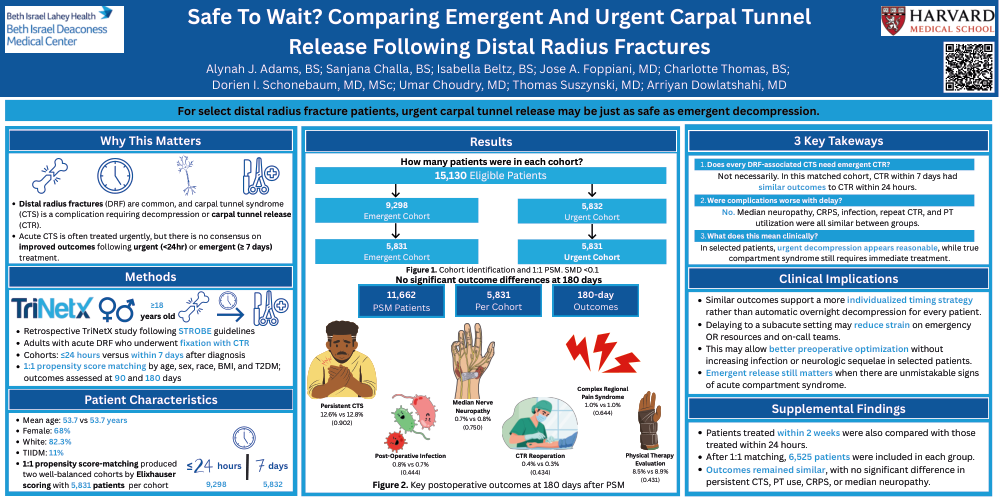
After 1:1 propensity score matching, 5,831 patients who underwent CTR and were
diagnosed with DRF within 24 hours were compared to an equal number of patients
who underwent CTR within 7 days. At 180 days postoperatively, both emergent and
urgent groups had similar rates of CTS diagnosis, median nerve release procedures,
and physical therapy evaluations (p>0.05). Additionally, infection rates, median nerve
neuropathy, and complex regional pain syndrome were similar between the groups
(p>0.05).
Conclusions
Among patients undergoing CTR within 7 days after distal radius fracture, outcomes
were similar to those treated within 24 hours, suggesting that carefully selected
patients may not require emergent decompression. Importantly, there was no
significant difference in the rate of median nerve neuropath regardless of surgical
timing.