206 posters, 13 topics, 5 sessions, 713 authors, 293 institutions
ePostersLive by SciGen Technologies S.A. All rights reserved.
AAPS 104th Annual Meeting
May 2-5, 2026 | Lihue, HI

D126
Paradoxical Increase In Cubital Tunnel Syndrome Risk Among Glp-1 Agonist Users Despite Obesity As An Independent Risk Factor
Poster Presenter
Authors
Affiliations
Part of Topic
Hand/Upper Extremity
OBJECTIVES
Assess the impact of poor metabolic health on the risk of cubital tunnel
syndrome.
Clarify the effect of aggressive management of metabolic disease by GLP-
1 agonists on the risk of developing cubital tunnel syndrome.
INTRODUCTION
• Cubital tunnel syndrome (CuTS) is the second most common compressive
neuropathy of the upper extremity, with a reported incidence of approximately
30 per 100,000 person-years. 1
• CuTS may result in significant morbidity including: intrinsic muscle atrophy,
debilitating pain, and hand contractures, significantly impairing fine motor skills
and decreasing overall quality of life. 2
• The development of compressive neuropathies has been increasingly linked to
systemic metabolic disease. 3,4
• While diabetes is a well-established independent risk factor for compressive
neuropathies, the relationship between body mass index (BMI) and CuTS is more
complex. 3,4
• Glucagon-like peptide-1 receptor agonists (GLP-1 RAs) are at the forefront of
contemporary weight-loss therapy, although their impact on peripheral
compressive neuropathies remains poorly defined.
CONCLUSIONS
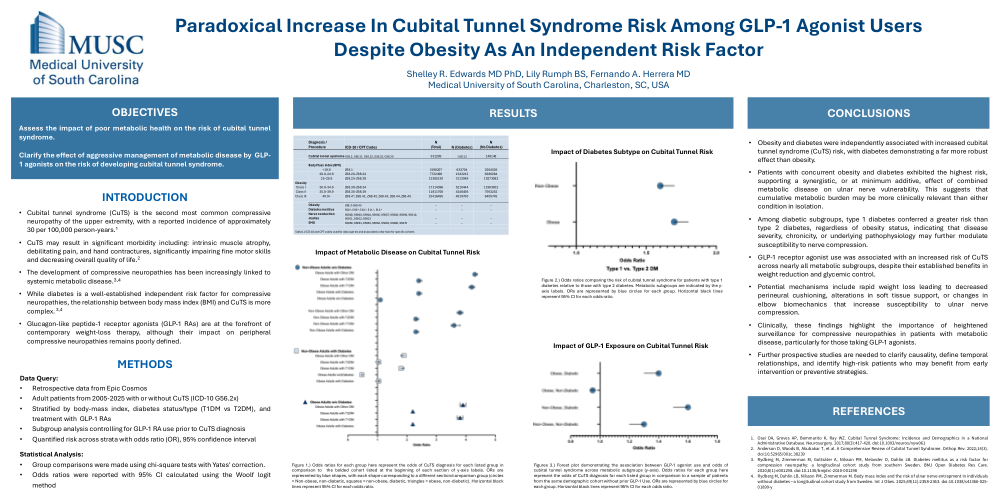
• Obesity and diabetes were independently associated with increased cubital
tunnel syndrome (CuTS) risk, with diabetes demonstrating a far more robust
effect than obesity.
• Patients with concurrent obesity and diabetes exhibited the highest risk,
supporting a synergistic, or at minimum additive, effect of combined
metabolic disease on ulnar nerve vulnerability. This suggests that
cumulative metabolic burden may be more clinically relevant than either
condition in isolation.
• Among diabetic subgroups, type 1 diabetes conferred a greater risk than
type 2 diabetes, regardless of obesity status, indicating that disease
severity, chronicity, or underlying pathophysiology may further modulate
susceptibility to nerve compression.
• GLP-1 receptor agonist use was associated with an increased risk of CuTS
across nearly all metabolic subgroups, despite their established benefits in
weight reduction and glycemic control.
• Potential mechanisms include rapid weight loss leading to decreased
perineural cushioning, alterations in soft tissue support, or changes in
elbow biomechanics that increase susceptibility to ulnar nerve
compression.
• Clinically, these findings highlight the importance of heightened
surveillance for compressive neuropathies in patients with metabolic
disease, particularly for those taking GLP-1 agonists.
• Further prospective studies are needed to clarify causality, define temporal
relationships, and identify high-risk patients who may benefit from early
intervention or preventive strategies