206 posters, 13 topics, 5 sessions, 713 authors, 293 institutions
ePostersLive by SciGen Technologies S.A. All rights reserved.
AAPS 104th Annual Meeting
May 2-5, 2026 | Lihue, HI

PC42
Comparative Outcomes Of Single Versus Multiple Trigger Finger Releases: A Propensity Score Matched Cohort Study
Poster Presenter
Part of Topic
Hand/Upper Extremity
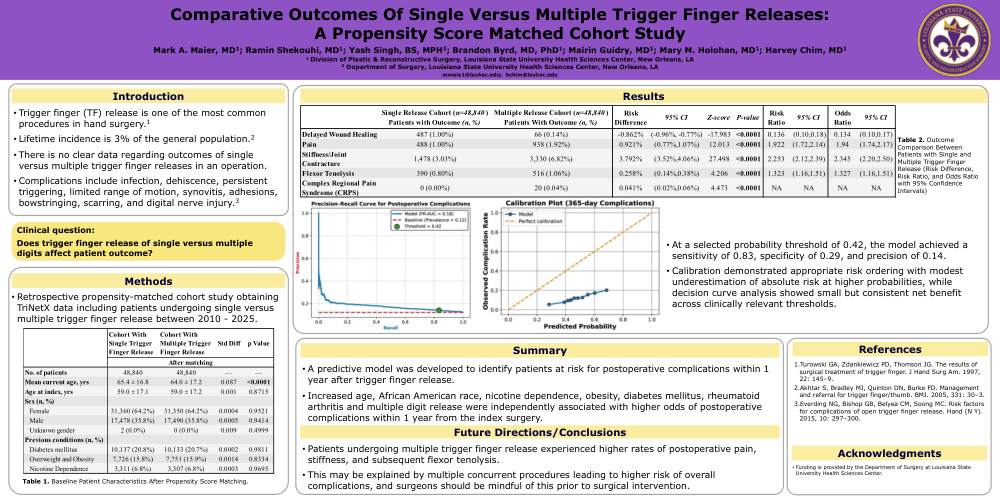
Comparative Outcomes Of Single Versus Multiple Trigger Finger Releases: A Propensity Score Matched Cohort Study Mark A. Maier, MD1; Ramin Shekouhi, MD1; Yash Singh, BS, MPH2; Brandon Byrd, MD, PhD1; Mairin Guidry, MD1; Mary M. Holohan, MD1; Harvey Chim, MD1 1 Division of Plastic & Reconstructive Surgery, Louisiana State University Health Sciences Center, New Orleans, LA 2 Department of Surgery, Louisiana State University Health Sciences Center, New Orleans, LA mmaie1@lsuhsc.edu; hchim@lsuhsc.edu Introduction • Trigger finger (TF) release is one of the most common procedures in hand surgery.1 • Lifetime incidence is 3% of the general population.2 Results Single Release Cohort (n=48,840 ) Patients with Outcome (n, %) Delayed Wound Healing 487 (1.00%) Multiple Release Cohort (n=48,840 ) Patients With Outcome (n, %) 66 (0.14%) Risk Difference 95% CI Z-score P-value Risk Ratio 95% CI Odds Ratio 95% CI-0.862% (-0.96%, -0.77%)-17.983 <0.0001 0.136 (0.10,0.18) 0.134 (0.10,0.17) Pain • There is no clear data regarding outcomes of single versus multiple trigger finger releases in an operation. • Complications include infection, dehiscence, persistent triggering, limited range of motion, synovitis, adhesions, bowstringing, scarring, and digital nerve injury.3 Stiffness/Joint Contracture Flexor Tenolysis Complex Regional Pain Syndrome (CRPS) 488 (1.00%) 1,478 (3.03%) 390 (0.80%) 938 (1.92%) 3,330 (6.82%) 516 (1.06%) 0.921% 3.792% 0.258% (0.77%,1.07%) 12.013 <0.0001 1.922 (1.72,2.14) 1.94 (1.74,2.17) (3.52%,4.06%) 27.498 <0.0001 2.253 (2.12,2.39) 2.345 (2.20,2.50) (0.14%,0.38%) 4.206 <0.0001 1.323 (1.16,1.51) 1.327 (1.16,1.51) 0 (0.00%) Clinical question: Does trigger finger release of single versus multiple digits affect patient outcome? 20 (0.04%) 0.041% (0.02%,0.06%) 4.473 <0.0001 NA NA NA NA Table 2. Outcome Comparison Between Patients with Single and Multiple Trigger Finger Release (Risk Difference, Risk Ratio, and Odds Ratio with 95% Confidence Intervals) • At a selected probability threshold of 0.42, the model achieved a sensitivity of 0.83, specificity of 0.29, and precision of 0.14. Methods • Retrospective propensity-matched cohort study obtaining TriNetX data including patients undergoing single versus multiple trigger finger release between 2010 - 2025. Cohort With Single Trigger Finger Release No. of patients Mean current age, yrs Age at index, yrs Sex (n, %) Female Male Unknown gender Previous conditions (n, %) Diabetes mellitus 48,840 65.4 ± 16.8 59.0 ± 17.1 Cohort With Multiple Trigger Finger Release Std Diff p Value After matching 48,840 64.0 ± 17.2 — 0.087 — <0.0001 59.0 ± 17.2 0.001 0.8715 31,360 (64.2%) 31,350 (64.2%) 0.0004 0.9521 17,478 (35.8%) 17,490 (35.8%) 0.0005 0.9414 2 (0.0%) 0 (0.0%) 0.009 0.4999 10,137 (20.8%) 10,133 (20.7%) 0.0002 0.9811 Overweight and Obesity Nicotine Dependence 7,726 (15.8%) 3,311 (6.8%) 7,751 (15.9%) 3,307 (6.8%) 0.0014 0.0003 Table 1. Baseline Patient Characteristics After Propensity Score Matching. 0.8334 0.9695 • Calibration demonstrated appropriate risk ordering with modest underestimation of absolute risk at higher probabilities, while decision curve analysis showed small but consistent net benefit across clinically relevant thresholds. Summary • A predictive model was developed to identify patients at risk for postoperative complications within 1 year after trigger finger release. • Increased age, African American race, nicotine dependence, obesity, diabetes mellitus, rheumatoid arthritis and multiple digit release were independently associated with higher odds of postoperative complications within 1 year from the index surgery. Future Directions/Conclusions • Patients undergoing multiple trigger finger release experienced higher rates of postoperative pain, stiffness, and subsequent flexor tenolysis. • This may be explained by multiple concurrent procedures leading to higher risk of overall complications, and surgeons should be mindful of this prior to surgical intervention. References 1.Turowski GA, Zdankiewicz PD, Thomson JG. The results of surgical treatment of trigger finger. J Hand Surg Am. 1997, 22: 145–9. 2.Akhtar S, Bradley MJ, Quinton DN, Burke FD. Management and referral for trigger finger/thumb. BMJ. 2005, 331: 30–3. 3.Everding NG, Bishop GB, Belyea CM, Soong MC. Risk factors for complications of open trigger finger release. Hand (N Y). 2015, 10: 297–300.