206 posters, 13 topics, 5 sessions, 713 authors, 293 institutions
ePostersLive by SciGen Technologies S.A. All rights reserved.
AAPS 104th Annual Meeting
May 2-5, 2026 | Lihue, HI

PC41
Comparative Analysis Of Robotic Versus Open Component Separation: A Propensity Score-matched Evaluation Of Complication Rates And Clinical Outcomes
Poster Presenter
Authors
Gabriel De la Cruz Ku, Silvana Maldonado, Carlos Gonzales, Anshumi Desai, Jiddu Guart, Alba Zeballos Ventura, Bryan Valcarcel, Joseph Escandon, Natalia Mejia, Camila Franco, Camila Amado Rottier, Donald Czerniach, Adam Walchak, Sameer Patel
Affiliations
Temple University Hospital, Universidad Cientifica del Sur, Lima, Peru, University of Miami School of Medicina, Miami, FL, University of Massuchetts Medical Scholl, Worcester, MA, USA, Loma Linda University CA, USA, MD Anderson Cancer Center, Houston, Texas, USA, Wyckoff Heights Medical Center, Brooklyn, NY, USA, Temple University Hospital, Philadelphia, PA, USA, University of Texas Medical Branch at Galveston, Galveston, TX, USA, Hospital Guillermo Almenara Irigoyen, Lima, Peru, University of Massachusetts Medical School, Worcester, MA, USA
Part of Topic
General Reconstruction
Background
• Complex ventral hernias are defined as fascial defects >10 cm or a rectus width-to-defect ratio <2:1.
• Global prevalence ~5%, with ~600,000 repairs annually in the United States
• Annual healthcare costs have risen to $9.7 billion
• Component separation is the standard technique, performed via open or minimally invasive (robotic/laparoscopic) approaches
Objectives
• Compare outcomes of robotic vs open component separation for complex ventral hernia repair
• Address limitations of prior studies, which are largely small, retrospective, and heterogeneous
• Provide large-scale, risk-adjusted analysis to better define clinical outcomes
Methods
• Study design: Retrospective cohort study using ACS-NSQIP database
• Case identification:
ICD-10: K43.2, K43.9 (ventral hernias)
CPT: 15734, 49659 (component separation)
Robotic cases confirmed using NSQIP robotic variable
• Cohort definition:
Open component separation
Robotic component separation
• Outcomes:
30-day morbidity and complication rates
• Analysis:
Multivariate logistic regression to identify risk factors for complications
Discussion
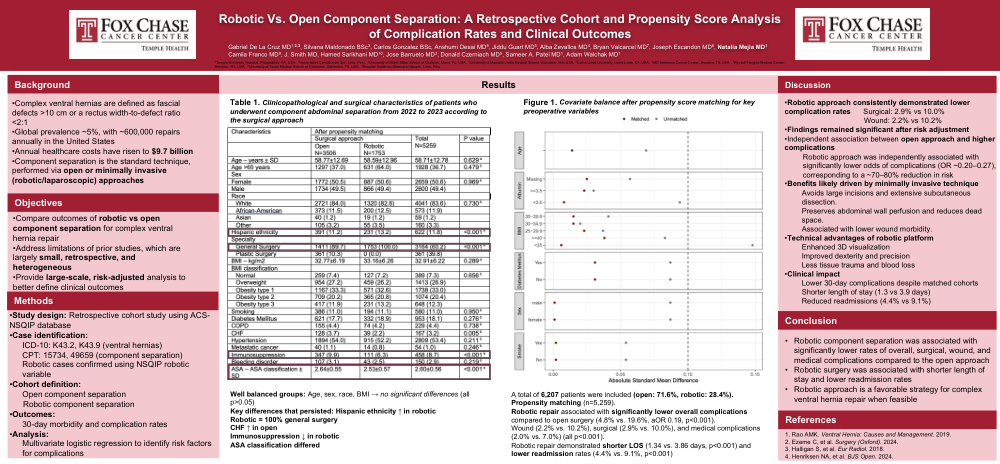
• Robotic approach consistently demonstrated lower complication rates
Surgical: 2.9% vs 10.0%
Wound: 2.2% vs 10.2%
• Findings remained significant after risk adjustment
• Independent association between open approach and higher complications
Robotic approach was independently associated with significantly lower odds of complications (OR ~0.20–0.27), corresponding to a ~70–80% reduction in risk
• Benefits likely driven by minimally invasive technique
Avoids large incisions and extensive subcutaneous dissection
Preserves abdominal wall perfusion and reduces dead space
Associated with lower wound morbidity
• Technical advantages of robotic platform
Enhanced 3D visualization
Improved dexterity and precision
Less tissue trauma and blood loss
• Clinical impact
Lower 30-day complications despite matched cohorts
Shorter length of stay (1.3 vs 3.9 days)
Reduced readmissions (4.4% vs 9.1%)
Conclusion
• Robotic component separation was associated with significantly lower rates of overall, surgical, wound, and medical complications compared to the open approach
• Robotic surgery was associated with shorter length of stay and lower readmission rates
• Robotic approach is a favorable strategy for complex ventral hernia repair when feasible