206 posters, 13 topics, 5 sessions, 713 authors, 293 institutions
ePostersLive by SciGen Technologies S.A. All rights reserved.
AAPS 104th Annual Meeting
May 2-5, 2026 | Lihue, HI

D107
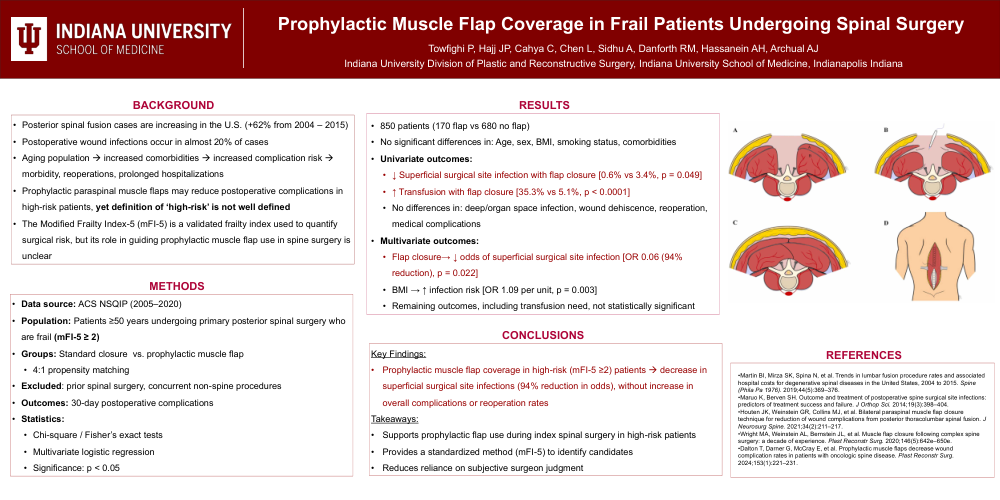
Prophylactic Muscle Flap Coverage In Frail Patients Undergoing Spinal Surgery
Part of Topic
General Reconstruction
Background:
•Posterior spinal fusion cases are increasing in the U.S. (+62% from 2004 – 2015)
•Postoperative wound infections occur in almost 20% of cases
•Aging population à increased comorbidities à increased complication risk à morbidity, reoperations, prolonged hospitalizations
•Prophylactic paraspinal muscle flaps may reduce postoperative complications in high-risk patients, yet definition of ‘high-risk’ is not well defined
•The Modified Frailty Index-5 (mFI-5) is a validated frailty index used to quantify surgical risk, but its role in guiding prophylactic muscle flap use in spine surgery is unclear
Methods:
•Data source: ACS NSQIP (2005–2020)
•Population: Patients ≥50 years undergoing primary posterior spinal surgery who are frail (mFI-5 ≥ 2)
•Groups: Standard closure vs. prophylactic muscle flap
•4:1 propensity matching
•Excluded: prior spinal surgery, concurrent non-spine procedures
•Outcomes: 30-day postoperative complications
•Statistics:
•Chi-square / Fisher’s exact tests
•Multivariate logistic regression
•Significance: p < 0.05
Results:
•850 patients (170 flap vs 680 no flap)
•No significant differences in: Age, sex, BMI, smoking status, comorbidities
•Univariate outcomes:
•↓ Superficial surgical site infection with flap closure [0.6% vs 3.4%, p = 0.049]
•↑ Transfusion with flap closure [35.3% vs 5.1%, p < 0.0001]
•No differences in: deep/organ space infection, wound dehiscence, reoperation, medical complications
•Multivariate outcomes:
•Flap closure→ ↓ odds of superficial surgical site infection [OR 0.06 (94% reduction), p = 0.022]
•BMI → ↑ infection risk [OR 1.09 per unit, p = 0.003]
•Remaining outcomes, including transfusion need, not statistically significant
Conclusions:
Key Findings:
•Prophylactic muscle flap coverage in high-risk (mFI-5 ≥2) patients à decrease in superficial surgical site infections (94% reduction in odds), without increase in overall complications or reoperation rates
Takeaways:
•Supports prophylactic flap use during index spinal surgery in high-risk patients
•Provides a standardized method (mFI-5) to identify candidates
•Reduces reliance on subjective surgeon judgment