206 posters, 13 topics, 5 sessions, 713 authors, 293 institutions
ePostersLive by SciGen Technologies S.A. All rights reserved.
AAPS 104th Annual Meeting
May 2-5, 2026 | Lihue, HI

PC37
Preoperative Botulinum Toxin A In Abdominal Wall Reconstruction: Five-year Propensity-matched Outcomes In >5,000 Patients
Poster Presenter
Part of Topic
General Reconstruction
Preoperative Botulinum Toxin A In Abdominal Wall Reconstruction: Five-year Propensity-matched Outcomes In >5,000 Patients
Yousef Tanas, MD1, Stephen Chen, BS2, Philong Nguyen, BS3, Joshua Wang, MS3, Tue Dinh, MD1.
1Houston Methodist Hospital, Houston, TX, USA, 2Baylor College of Medicine, Houston, TX, USA, 3University of Texas Medical Branch, Galveston, TX, USA.
PURPOSE: Preoperative botulinum toxin A (BTA) is used in abdominal wall reconstruction (AWR) to facilitate fascial closure. Long-term safety and outcomes remain unclear.
METHODS: Patients undergoing AWR with or without BTA were identified in the TriNetX US Collaborative Network. Propensity score matching was performed at each time point, yielding 1:1 balanced cohorts for all timepoints (6 months: 2,255 patients per cohort; 1 year: 2,508 patients per cohort; 3 years: 2,279 patients per cohort; 5 years: 2,432 patients per cohort). Outcomes assessed at every timepoint included hernia recurrence, reoperation, wound disruption, seroma, hematoma, surgical site infection (SSI), and overall infections.
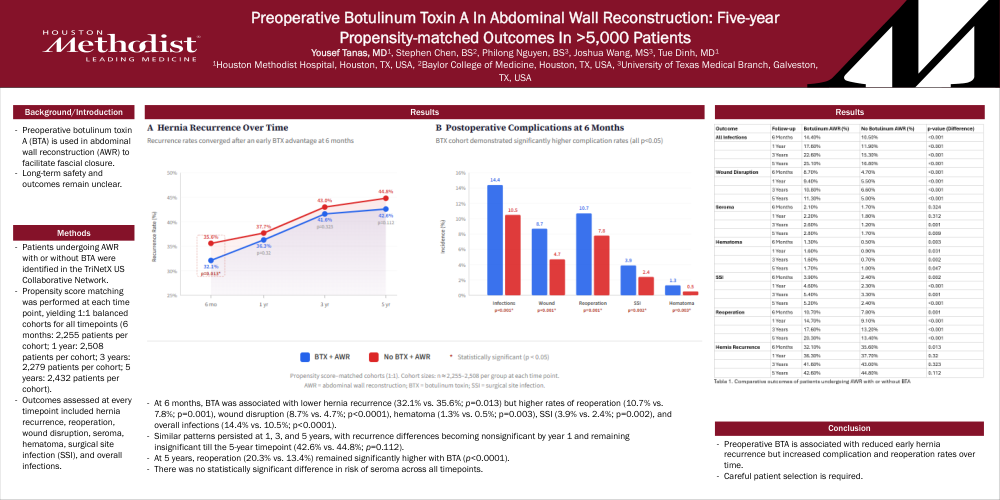
RESULTS: At 6 months, BTA was associated with lower hernia recurrence (32.1% vs. 35.6%; p=0.013) but higher rates of reoperation (10.7% vs. 7.8%; p=0.001), wound disruption (8.7% vs. 4.7%; p<0.0001), hematoma (1.3% vs. 0.5%; p=0.003), SSI (3.9% vs. 2.4%; p=0.002), and overall infections (14.4% vs. 10.5%; p<0.0001). Similar patterns persisted at 1, 3, and 5 years, with recurrence differences becoming nonsignificant by year 1 and remaining insignificant till the 5-year timepoint (42.6% vs. 44.8%; p=0.112). At 5 years, reoperation (20.3% vs. 13.4%) remained significantly higher with BTA (p<0.0001). There was no statistically significant difference in risk of seroma across all timepoints.
CONCLUSION: Preoperative BTA is associated with reduced early hernia recurrence but increased complication and reoperation rates over time. Careful patient selection is required.