206 posters, 13 topics, 5 sessions, 713 authors, 293 institutions
ePostersLive by SciGen Technologies S.A. All rights reserved.
AAPS 104th Annual Meeting
May 2-5, 2026 | Lihue, HI

PC60
GLP-1s And Free Flaps Don’t Mix: Emerging Risk In Reconstruction
Poster Presenter
Authors
Affiliations
Part of Topic
General Reconstruction
Background: GLP-1 receptor agonists are among the fastest-growing drug classes in the U.S. Systemic benefits are well characterized; implications in wound healing are not. Free tissue transfer depends on appropriate wound healing and tissue perfusion — mechanisms possibly modulated by GLP-1 signaling, delayed gastric emptying, or rapid weight loss. Hypothesis: Preoperative GLP-1 exposure is associated with increased postoperative complications following autologous free flap reconstruction.
Methods: Design: Single-institution retrospective cohort, 2015–2025. Population: Patients undergoing autologous free tissue transfer. Exposure: Preoperative GLP-1 receptor agonist use. Outcomes (30-day): Hospital complications, systemic complications, aspiration, donor-site infection, donor-site dehiscence. Analysis: Multivariable logistic regression adjusted for age, BMI, smoking, diabetes, chemotherapy, radiation, and hormone therapy. Adjusted odds ratios with 95% CI; two-sided α = 0.05.
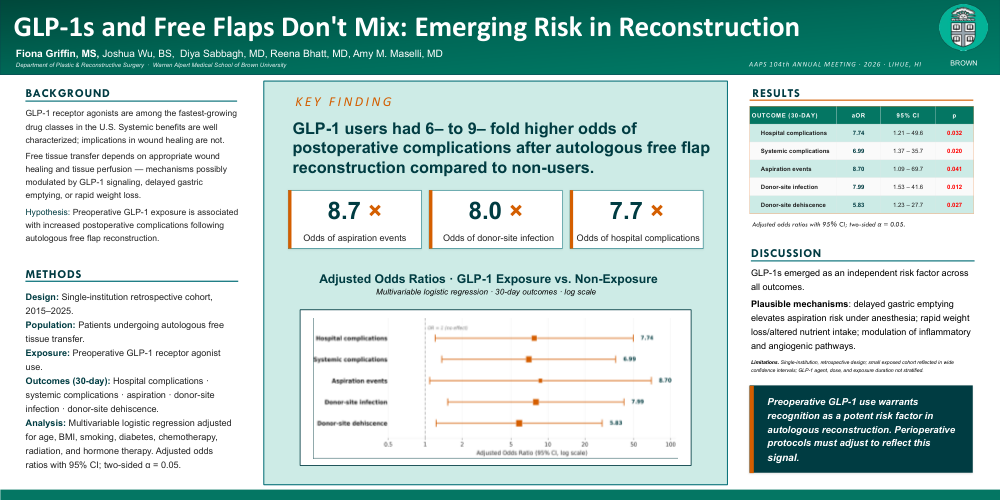
Key Finding: GLP-1 users had 6- to 9-fold higher odds of postoperative complications after autologous free flap reconstruction. Results table (30-day) [aOR (95% CI, p)]: Hospital complications, aOR 7.74 (1.21 – 49.6, 0.032); Systemic complications, aOR 6.99 (1.37 – 35.7, 0.020); Aspiration events, aOR 8.70 (1.09 – 69.7, 0.041); Donor-site infection, aOR 7.99 (1.53 – 41.6, 0.012); Donor-site dehiscence, aOR 5.83 (1.23 – 27.7, 0.027).
GLP-1s emerged as an independentrisk factor across all outcomes. Plausible mechanisms: delayed gastric emptying elevates aspiration risk under anesthesia; rapid weight loss/altered nutrient intake; modulation of inflammatory and angiogenic pathways. Limitations. Single-institution, retrospective design; small exposed cohort reflected in wide confidence intervals; GLP-1 agent, dose, and exposure duration not stratified. Preoperative GLP-1 use warrants recognition as a potent risk factor in autologous reconstruction. Perioperative protocols must adjust to reflect this signal.