206 posters, 13 topics, 5 sessions, 713 authors, 293 institutions
ePostersLive by SciGen Technologies S.A. All rights reserved.
AAPS 104th Annual Meeting
May 2-5, 2026 | Lihue, HI

D120
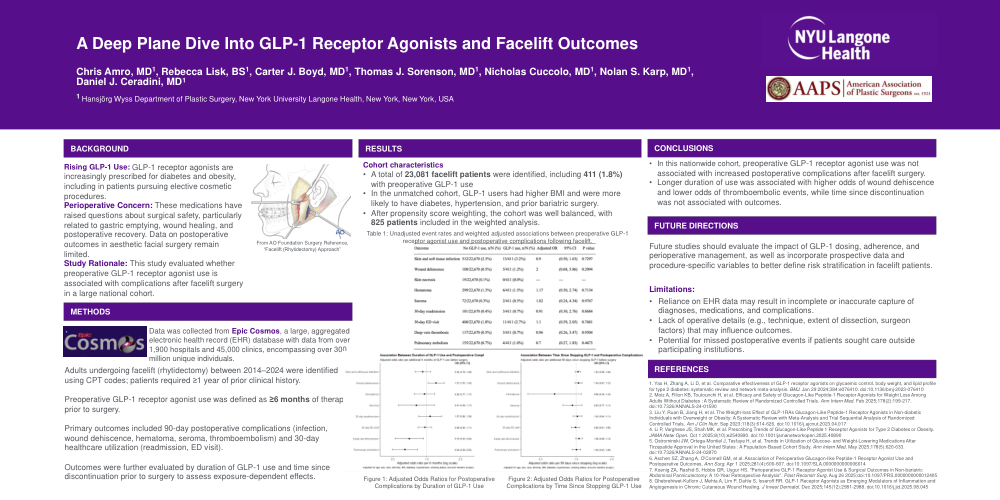
A Deep Plane Dive Into Glp-1 Receptor Agonists And Facelift Outcomes
Poster Presenter
Authors
Chris Amro, Rebecca Lisk, Carter J. Boyd, Thomas J. Sorenson, Nicholas Cuccolo, Nolan S. Karp, Daniel J. Ceradini
Affiliations
Part of Topic
Aesthetic Face
A Deep Plane Dive Into GLP-1 Receptor Agonists and Facelift Outcomes
Chris Amro, MD1, Rebecca Lisk, BS1, Carter J. Boyd, MD1, Thomas J. Sorenson, MD1, Nicholas Cuccolo, MD1, Nolan S. Karp, MD1, Daniel J. Ceradini, MD1
1 Hansjörg Wyss Department of Plastic Surgery, New York University Langone Health, New York, New York, USA
BACKGROUND
Rising GLP-1 Use: GLP-1 receptor agonists are increasingly prescribed for diabetes and obesity, including in patients pursuing elective cosmetic procedures.
Perioperative Concern: These medications have raised questions about surgical safety, particularly related to gastric emptying, wound healing, and postoperative recovery. Data on postoperative outcomes in aesthetic facial surgery remain limited.
Study Rationale: This study evaluated whether preoperative GLP-1 receptor agonist use is associated with complications after facelift surgery in a large national cohort.
METHODS
Data was collected from Epic Cosmos, a large, aggregated electronic health record (EHR) database with data from over 1,900 hospitals and 45,000 clinics, encompassing over 300 million unique individuals.
Adults undergoing facelift (rhytidectomy) between 2014–2024 were identified using CPT codes; patients required ≥1 year of prior clinical history.
Preoperative GLP-1 receptor agonist use was defined as ≥6 months of therapy prior to surgery.
Primary outcomes included 90-day postoperative complications (infection, wound dehiscence, hematoma, seroma, thromboembolism) and 30-day healthcare utilization (readmission, ED visit).
Outcomes were further evaluated by duration of GLP-1 use and time since discontinuation prior to surgery to assess exposure-dependent effects.
RESULTS
Cohort characteristics
CONCLUSIONS
FUTURE DIRECTIONS
Future studies should evaluate the impact of GLP-1 dosing, adherence, and perioperative management, as well as incorporate prospective data and procedure-specific variables to better define risk stratification in facelift patients.
Limitations: