206 posters, 13 topics, 5 sessions, 713 authors, 293 institutions
ePostersLive by SciGen Technologies S.A. All rights reserved.
AAPS 104th Annual Meeting
May 2-5, 2026 | Lihue, HI

D81
A Comparative Analysis Of The Complications Following Surgical Correction Of Microgenia
Poster Presenter
Authors
Diwakar Phuyal, Filippo Perozzo, Kyle Barclay, Yomna Dean, Sara Yacoub, Antonio Rampazzo, Bahar Bassiri Gharb
Affiliations
Part of Topic
Aesthetic Face
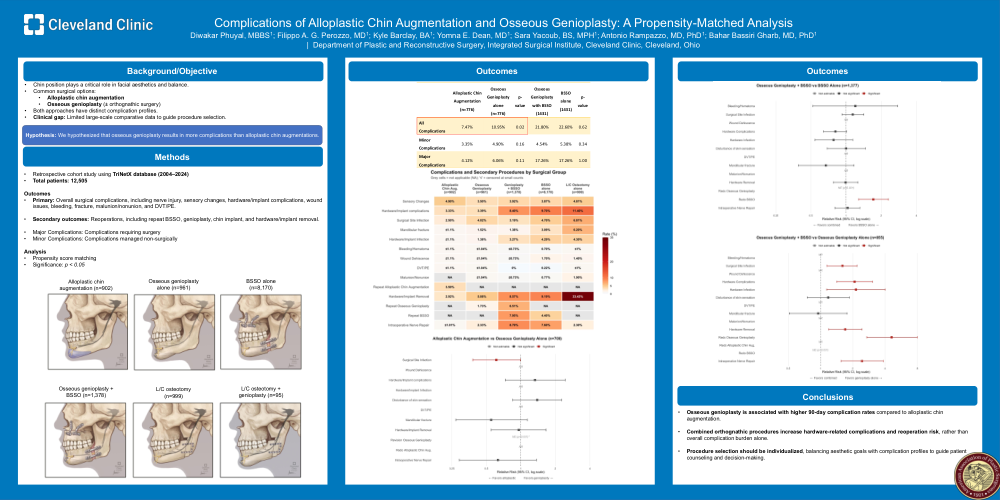
Complications of Alloplastic Chin Augmentation and Osseous Genioplasty: A Propensity-Matched Analysis
Diwakar Phuyal, MBBS; Filippo A. G. Perozzo, MD; Kyle Barclay, BA; Yomna E. Dean, MD; Sara Yacoub, BS, MPH; Antonio Rampazzo, MD, PhD; Bahar Bassiri Gharb, MD, PhD
Department of Plastic and Reconstructive Surgery, Cleveland Clinic, Cleveland, Ohio
Background:
Chin position plays a critical role in facial aesthetics and balance. Common surgical options include alloplastic chin augmentation and osseous genioplasty. Both approaches have distinct complication profiles, but there is limited large-scale comparative data to guide procedure selection.
Objective:
To compare complication rates between alloplastic chin augmentation and osseous genioplasty using a large propensity-matched cohort.
Methods:
A retrospective cohort study was performed using the TriNetX database (2004–2024), including 12,505 patients. Outcomes included overall complications, minor and major complications, and reoperations. Primary complications included nerve injury, sensory changes, hardware or implant complications, bleeding, fracture, malunion or nonunion, and DVT/PE. Secondary outcomes included reoperations such as repeat BSSO, genioplasty, implant placement, or hardware removal. Propensity score matching was used, with statistical significance set at p < 0.05.
Results:
Alloplastic chin augmentation demonstrated a lower overall complication rate compared to osseous genioplasty (7.47% vs 10.95%, p = 0.02). Minor complications (3.35% vs 4.90%, p = 0.16) and major complications (4.12% vs 6.06%, p = 0.11) were not significantly different.
When comparing osseous genioplasty with BSSO to BSSO alone, overall complication rates were similar (21.80% vs 22.60%, p = 0.62). However, combined procedures were associated with higher rates of hardware-related complications and reoperations.
Conclusion:
Osseous genioplasty is associated with higher 90-day complication rates compared to alloplastic chin augmentation. Combined orthognathic procedures increase hardware-related complications and reoperation risk. Procedure selection should be individualized, balancing aesthetic goals with complication profiles to guide patient counseling and surgical decision-making.
Keywords:
Chin augmentation, genioplasty, orthognathic surgery, BSSO, complications, TriNetX, facial aesthetics, plastic surgery outcomes