206 posters, 13 topics, 5 sessions, 713 authors, 293 institutions
ePostersLive by SciGen Technologies S.A. All rights reserved.
AAPS 104th Annual Meeting
May 2-5, 2026 | Lihue, HI

D84
Limiting Donor Site Morbidity In Autograft Nerve Reconstruction: Comparing Sural Nerve Grafts With And Without TMR To Motor Nerve Grafts
Part of Topic
Hand/Upper Extremity
Introduction
-
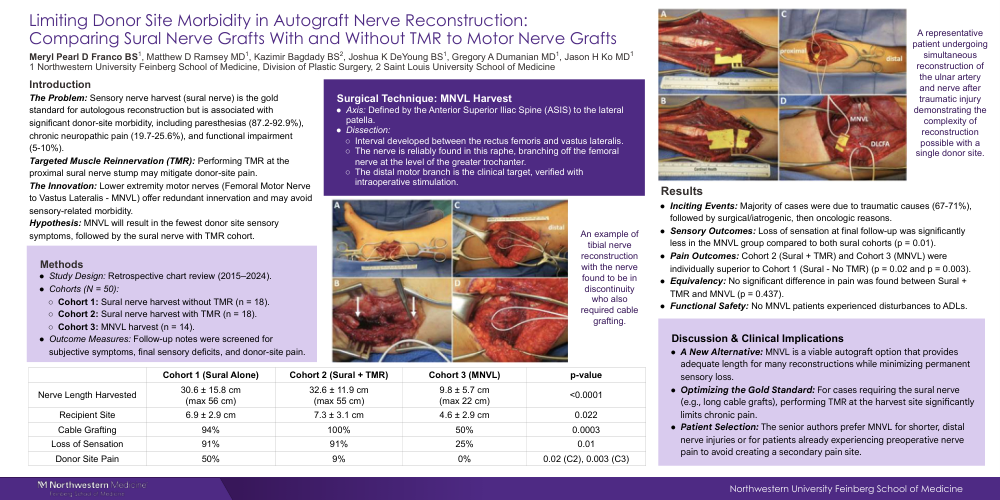
The Problem: Sensory nerve harvest (sural nerve) is the gold standard for autologous reconstruction but is associated with significant donor-site morbidity, including paresthesias (87.2-92.9%), chronic neuropathic pain (19.7-25.6%), and functional impairment (5-10%).
-
Targeted Muscle Reinneration (TMR): Performing TMR at the proximal sural nerve stump may mitigate donor-site pain.
-
The Innovation: Lower extremity motor nerves (Femoral Motor Nerve to Vastus Lateralis - MNVL) offer redundant innervation and may avoid sensory-related morbidity.
-
Hypothesis: MNVL will result in the fewest donor site sensory symptoms, followed by the sural nerve with TMR cohort.
Methods
-
Study Design: Retrospective chart review (2015–2024).
-
Cohorts (N = 50):
-
Cohort 1: Sural nerve harvest without TMR (n = 18).
-
Cohort 2: Sural nerve harvest with TMR (n = 18).
-
Cohort 3: MNVL harvest (n = 14).
-
Outcome Measures: Follow-up notes were screened for subjective symptoms, final sensory deficits, and donor-site pain.
Surgical Technique: MNVL Harvest
-
Axis: Defined by the Anterior Superior Iliac Spine (ASIS) to the lateral patella.
-
Dissection:
-
Interval developed between the rectus femoris and vastus lateralis.
-
The nerve is reliably found in this raphe, branching off the femoral nerve at the level of the greater trochanter.
-
The distal motor branch is the clinical target, verified with intraoperative stimulation.
Results
-
Inciting Events: Majority of cases were due to traumatic causes (67-71%), followed by surgical/iatrogenic, then oncologic reasons.
-
Sensory Outcomes: Loss of sensation at final follow-up was significantly less in the MNVL group compared to both sural cohorts (p = 0.01).
-
Pain Outcomes: Cohort 2 (Sural + TMR) and Cohort 3 (MNVL) were individually superior to Cohort 1 (Sural - No TMR) (p = 0.02 and p = 0.003).
-
Equivalency: No significant difference in pain was found between Sural + TMR and MNVL (p = 0.437).
-
Functional Safety: No MNVL patients experienced disturbances to ADLs.
Discussion & Clinical Implications
-
A New Alternative: MNVL is a viable autograft option that provides adequate length for many reconstructions while minimizing permanent sensory loss.
-
Optimizing the Gold Standard: For cases requiring the sural nerve (e.g., long cable grafts), performing TMR at the harvest site significantly limits chronic pain.
-
Patient Selection: The senior authors prefer MNVL for shorter, distal nerve injuries or for patients already experiencing preoperative nerve pain to avoid creating a secondary pain site.