206 posters, 13 topics, 5 sessions, 713 authors, 293 institutions
ePostersLive by SciGen Technologies S.A. All rights reserved.
AAPS 104th Annual Meeting
May 2-5, 2026 | Lihue, HI

D121
Neurodevelopmental Disorders And Cleft Surgery Outcomes: A Retrospective Cohort Study From The Global Collaborative Network
Poster Presenter
Authors
Emanuella Brito, Kate Jensen, James Gaston, Antonio Rampazzo, Bahar Bassiri Gharb
Affiliations
Part of Topic
Craniofacial/Peds
Neurodevelopmental Disorders and Cleft Surgery Outcomes:
A Retrospective Cohort Study From the U.S. Collaborative Network
Emanuella M. Brito, Kate K. Jensen, James O. Gaston, Kyle Barclay, Antonio Rampazzo, MD PhD, Bahar Bassiri Gharb, MD PhD
Department of Plastic and Reconstructive Surgery, Cleveland Clinic Foundation
Background
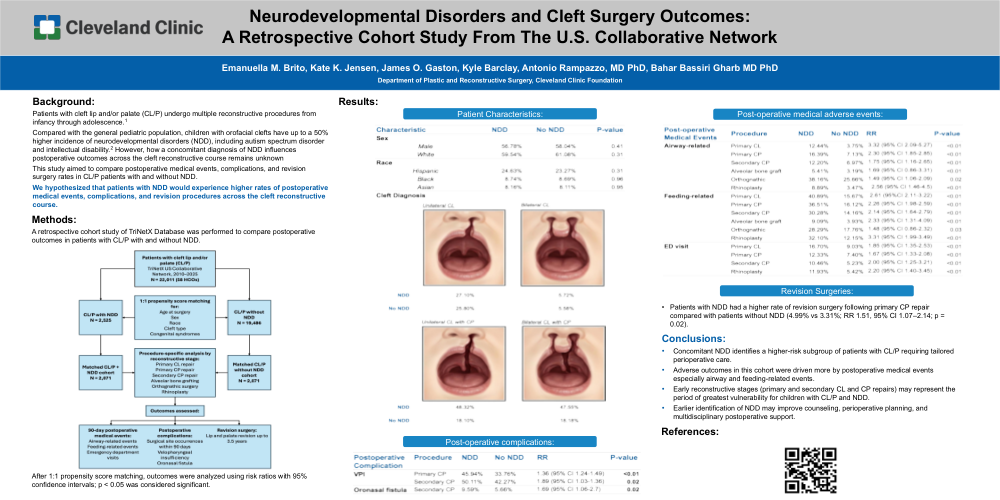
Patients with cleft lip and/or palate (CL/P) undergo multiple reconstructive procedures from infancy through adolescence. Compared with the general pediatric population, children with orofacial clefts have up to a 50% higher incidence of neurodevelopmental disorders (NDD), including autism spectrum disorder and intellectual disability. However, how a concomitant diagnosis of NDD influences postoperative outcomes across the cleft reconstructive course remains unknown.
This study aimed to compare postoperative medical adverse events, complications, and revision surgery rates in patients with CL/P with and without NDD. We hypothesized that patients with NDD would experience higher rates of postoperative medical adverse events, complications, and revision procedures across the cleft reconstructive course.
Methods
A retrospective cohort study of the TriNetX Database was performed to compare postoperative outcomes in patients with CL/P with and without NDD.
After 1:1 propensity score matching, outcomes were analyzed using risk ratios with 95% confidence intervals. A p value less than 0.05 was considered statistically significant.
Results
After matching, patients with CL/P and NDD were compared with patients with CL/P without NDD across multiple reconstructive stages.
Postoperative medical adverse events
Patients with NDD experienced higher rates of postoperative medical adverse events, particularly airway-related and feeding-related events, across several stages of cleft reconstruction. Emergency department visits were also increased in some reconstructive groups. These findings suggest that postoperative risk in this population is driven more by medical events than by surgical complications alone.
Postoperative complications
Patients with NDD had increased rates of selected postoperative complications, including velopharyngeal insufficiency and oronasal fistula after cleft palate procedures.
Revision surgery
Patients with NDD had a higher rate of revision surgery following primary cleft palate repair compared with patients without NDD (4.99% vs 3.31%; RR 1.51, 95% CI 1.07 to 2.14; p = 0.02).
Conclusions
Concomitant NDD identifies a higher-risk subgroup of patients with CL/P requiring tailored perioperative care.
Adverse outcomes in this cohort were driven more by postoperative medical events, especially airway-related and feeding-related events.
Early reconstructive stages, particularly primary and secondary cleft lip and cleft palate repairs, may represent the period of greatest vulnerability for children with CL/P and NDD.
Earlier identification of NDD may improve counseling, perioperative planning, and multidisciplinary postoperative support.