206 posters, 13 topics, 5 sessions, 713 authors, 293 institutions
ePostersLive by SciGen Technologies S.A. All rights reserved.
AAPS 104th Annual Meeting
May 2-5, 2026 | Lihue, HI

D119
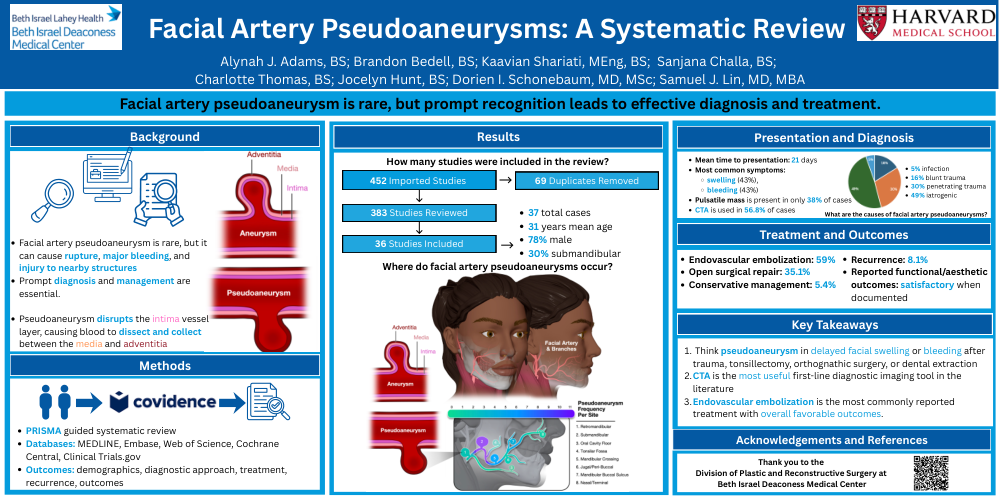
Facial Artery Pseudoaneurysms: Insights Into A Rare Occurrence — A Systematic Review Of 39 Cases
Poster Presenter
Authors
Alynah J. Adams, BS, Brandon Bedell, BS, Kaavian Shariati, MEng, BS, Sanjana Challa, BS, Charlotte Thomas, BS, Jocelyn Hunt, Dorien I. Schonebaum, MD, MSc, Samuel J. Lin, MD, MBA
Affiliations
Beth Israel Deaconess Medical Center & Harvard Medical School, Division of Plastic Surgery, Beth Israel Deaconess Medical Center; Harvard Medical School, Boston, MA, Medical College of Wisconsin, School of Medicine, Wauwatosa, WI, David Geffen School of Medicine, University of California, Los Angeles, Los Angeles, CA, University of North Carolina, School of Medicine, Chapel Hill, NC
Part of Topic
Craniofacial/Peds
Introduction
Facial artery pseudoaneurysm is a rare but serious condition that can develop after traumatic or iatrogenic injury. If undetected or untreated, it risks rupture, massive bleeding, and damage to nearby structures, potentially leading to life-threatening complications. Prompt diagnosis and treatment are essential to prevent these risks, with options including surgical repair or endovascular embolization.
Methods
This systematic review followed PRISMA guidelines and conducted comprehensive searches of MEDLINE, Embase, Web of Science, Cochrane Central, and ClinicalTrials.gov for studies published through 2025, supplemented by manual citation searches. Extracted data included patient demographics, diagnostic approaches, management, and outcomes. Quality was assessed using the National Institutes of Health Quality Assessment tool. Findings were descriptively analyzed.
Results
During study selection, 452 studies were identified; 383 were screened, yielding 36 patient case reports of facial artery pseudoaneurysms. The mean patient age was 31 years, and 78% were male. Etiologies were primarily iatrogenic injury (49%) or traumatic injury (46%), with an average presentation time of 21 days. The most common site for pseudoaneurysm development was the submandibular region (30%). Management included open surgical repair (35%) or endovascular embolization (57%), with a recurrence rate of 8%.
Conclusion
Facial artery pseudoaneurysms are rare, usually resulting from traumatic or iatrogenic injury, and typically present within 21 days. Most are effectively treated with open surgical repair or endovascular embolization, with low recurrence and complication rates. Prompt diagnosis and management are crucial to preventing serious outcomes.