206 posters, 13 topics, 5 sessions, 713 authors, 293 institutions
ePostersLive by SciGen Technologies S.A. All rights reserved.
AAPS 104th Annual Meeting
May 2-5, 2026 | Lihue, HI

D127
Variable Anatomy Of The Lateral Upper Arm Pathway In Breast Cancer Survivors Without BCRL
Poster Presenter
Part of Topic
Lymphedema
Major Anatomic Variations of the Lateral Upper Arm Lymphatic Pathway
in Breast Cancer Survivors Without Lymphedema
Madeleine Givant, BS1; James E. Fanning, BS1; Angela Chen, BS1; Sarah Thomson, RN1; Kathleen Shillue, PT2; Aaron Fleishman, MPH1;
Kevin Donohoe, MD3; Dhruv Singhal, MD1
1. Division of Plastic Surgery, Beth Israel Deaconess Medical Center, Harvard Medical School, Boston, MA, USA
2. Department of Rehabilitation Services, Beth Israel Deaconess Medical Center, Harvard Medical School, Boston, MA, USA
3. Department of Nuclear Medicine, Beth Israel Deaconess Medical Center, Harvard Medical School, Boston, MA, USA
Background: Variations of upper extremity lymphatic anatomy have been theorized to reduce an individual’s risk of developing breast cancer-related lymphedema (BCRL). Prior cadaveric and in-vivo studies have described the lateral upper arm (LUA) pathway as a protective anatomic variant. We evaluated the LUA pathway in breast cancer survivors without BCRL following axillary lymph node dissection (ALND)
Methods: Breast cancer survivors without BCRL at least 2 years after ALND underwent lymphatic mapping of the at-risk upper extremity using indocyanine green (ICG) lymphography. LUA pathway phenotype, continuity with forearm lymphatic channels, and proximal visualization were assessed with immediate (t = 0 hours) and delayed (t = 6 hours) imaging. (Funding Source: NIH NHLBI R01HL157991)
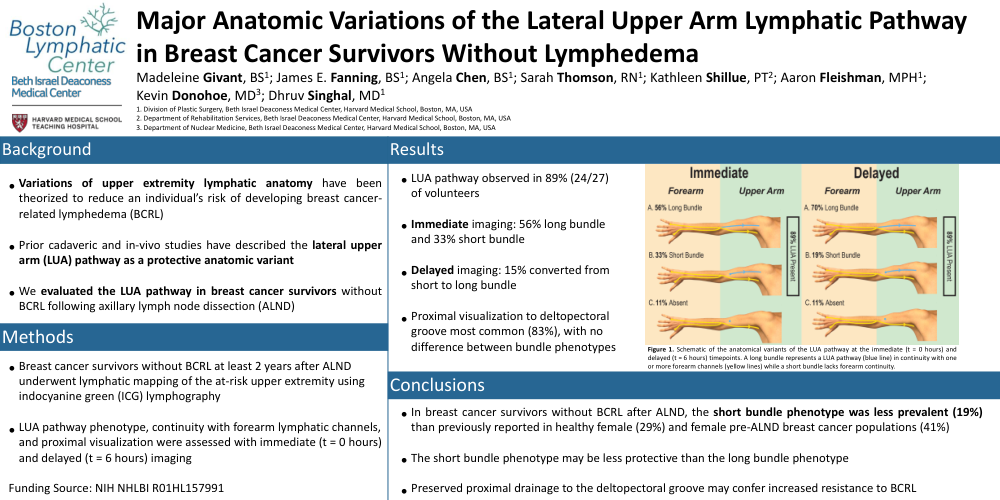
Results: LUA pathway observed in 89% (24/27) of volunteers. Immediate imaging: 56% long bundle and 33% short bundle. Delayed imaging: 15% converted from short to long bundle. Proximal visualization to deltopectoral groove most common (83%), with no difference between bundle phenotypes.
Conclusion: In breast cancer survivors without BCRL after ALND, the short bundle phenotype was less prevalent (19%) than previously reported in healthy female (29%) and female pre-ALND breast cancer populations (41%). The short bundle phenotype may be less protective than the long bundle phenotype. Preserved proximal drainage to the deltopectoral groove may confer increased resistance to BCRL