206 posters, 13 topics, 5 sessions, 713 authors, 293 institutions
ePostersLive by SciGen Technologies S.A. All rights reserved.
AAPS 104th Annual Meeting
May 2-5, 2026 | Lihue, HI

D79
Novel Artificial Intelligence Clinical Decision Support System For Craniofacial Surgery
Poster Presenter
Authors
Berk Ozmen, Nishant Singh, Kavach Shah, Ibrahim Berber, Eugene Pinsky, Graham Schwarz
Affiliations
Cleveland Clinic, Department of Plastic Surgery, Cleveland Clinic, Department of Computer Science, Metropolitan College, Boston University, Department of Computer Science, Metropolitan College, Boston University, Boston, Department of Computer Sciences, Case Western Reserve University
Part of Topic
Craniofacial/Peds
Novel Artificial Intelligence Clinical Decision Support System For Craniofacial Surgery
Background: Craniofacial surgery requires synthesis of complex, multidisciplinary knowledge, yet specialty-specific decision support tools are lacking. Retrieval-augmented generation (RAG) offers an opportunity to create transparent, evidence-based artificial intelligence (AI) systems tailored to surgical practice.
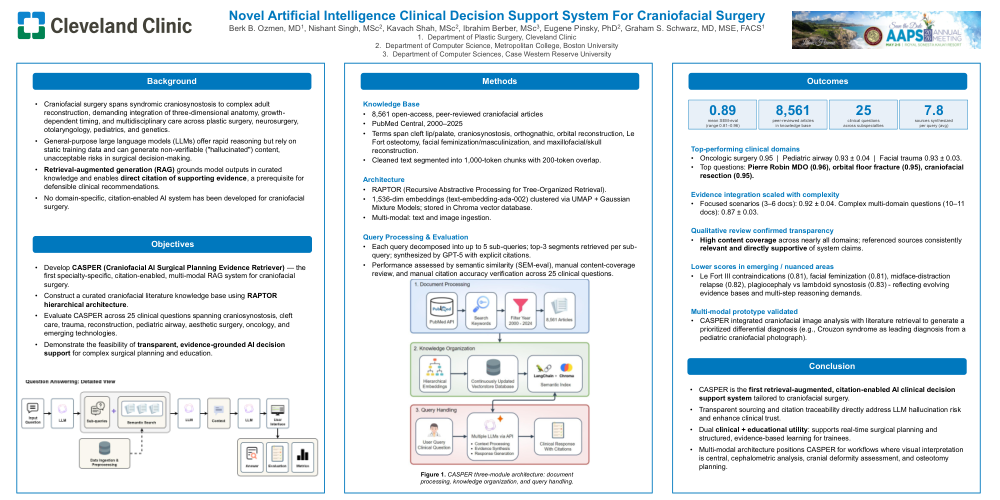
Methods: The authors developed CASPER, a domain-specific, multimodal RAG system with text and image analysis capabilities, built with RAPTOR hierarchical architecture and a knowledge base of 8561 open-access craniofacial surgery articles (2000-2025). The system retrieved and synthesized peer-reviewed literature in response to 25 clinical questions spanning craniofacial subspecialties. Performance was evaluated using semantic similarity (SEM-eval) to retrieved documents, manual content coverage review, and manual citation accuracy verification.
Results: CASPER achieved strong alignment with supporting literature (mean SEM-eval 0.89±0.04; range: 0.81-0.96), integrating an average of 7.8 sources per query. Highest performance was observed in pediatric airway (0.93), facial trauma (0.93), and oncologic surgery (0.95), with top scores for Pierre-Robin mandibular distraction (0.96) and orbital floor fracture management (0.95). Lower scores occurred in complex or emerging domains such as Le Fort III contraindications (0.81) and facial feminization planning (0.81). Manual review confirmed that CASPER maintained high content coverage across scenarios, with citations consistently accurate and directly supportive of system outputs.
Conclusions: CASPER is the first citation-enabled AI system for craniofacial surgery and demonstrates expert-comparable reasoning across diverse clinical scenarios. By delivering transparent, evidence-grounded recommendations, CASPER has the potential to enhance surgical planning, improve decision-making consistency, and accelerate knowledge translation in both clinical practice and surgical education.