206 posters, 13 topics, 5 sessions, 713 authors, 293 institutions
ePostersLive by SciGen Technologies S.A. All rights reserved.
AAPS 104th Annual Meeting
May 2-5, 2026 | Lihue, HI

D57
Access At Odds With Demand: Lower Cleft Orthodontia Reimbursement In States With High Pediatric Medicaid Enrollment
Poster Presenter
Part of Topic
Craniofacial/Peds
INTRODUCTION
Appropriate treatment of patients with cleft lip and palate (CL/P) requires a multi-disciplinary team approach over many years of treatment.
Access to these teams is made even more difficult for patients on government insurance as they continue to face multiple financial and geographic barriers to care.
Although Medicaid expansion has sought to close care gaps by increasing eligibility for many and improving procedure cost-sharing, access to providers remains an obstacle for many low-income families.
AIM
This study investigates the association between Medicaid provider reimbursement for CL/P related procedures and state-level economic factors that influence access to proper care.
METHODS
Provider reimbursement rates for 2025 were collected from state websites for D8020 (Phase 1/Limited Orthodontic Treatment of Transitional Dentition), D8080 (Phase 2/Comprehensive Orthodontic Treatment of Adolescent Dentition), and 42210 (Palatoplasty for Cleft Palate with Bone Graft).
State-level cost of living index, poverty index, and the number of children enrolled in Medicaid and Children’s Health Insurance Program (CHIP) were obtained as of July 2025.
Pearson correlation and linear regression assessed associations between provider reimbursement and demographic factors (p<0.05).
RESULTS
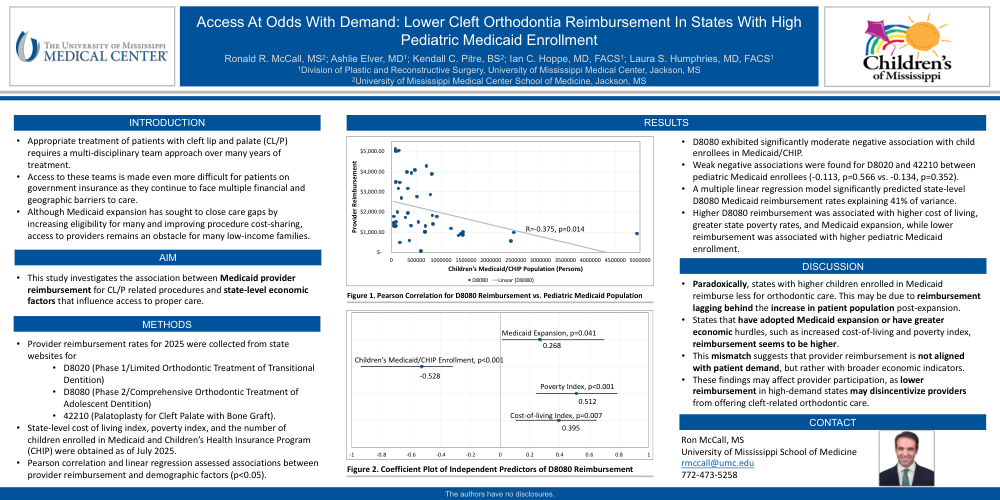
D8080 exhibited significantly moderate negative association with child enrollees in Medicaid/CHIP.
Weak negative associations were found for D8020 and 42210 between pediatric Medicaid enrollees (-0.113, p=0.566 vs. -0.134, p=0.352).
A multiple linear regression model significantly predicted state-level D8080 Medicaid reimbursement rates explaining 41% of variance.
Higher D8080 reimbursement was associated with higher cost of living, greater state poverty rates, and Medicaid expansion, while lower reimbursement was associated with higher pediatric Medicaid enrollment.
DISCUSSION
Paradoxically, states with higher children enrolled in Medicaid reimburse less for orthodontic care. This may be due to reimbursement lagging behind the increase in patient population post-expansion.
States that have adopted Medicaid expansion or have greater economic hurdles, such as increased cost-of-living and poverty index, reimbursement seems to be higher.
This mismatch suggests that provider reimbursement is not aligned with patient demand, but rather with broader economic indicators.
These findings may affect provider participation, as lower reimbursement in high-demand states may disincentivize providers from offering cleft-related orthodontic care.