206 posters, 13 topics, 5 sessions, 713 authors, 293 institutions
ePostersLive by SciGen Technologies S.A. All rights reserved.
AAPS 104th Annual Meeting
May 2-5, 2026 | Lihue, HI

D48
Age At Surgery Is Associated With Neurodevelopmental And Ophthalmologic Outcomes In Sagittal Craniosynostosis
Poster Presenter
Authors
Rachel S Lee BS, Caroline E Baker BSE, Theresa H Nguyen BS, Victoria Vespa BS, Morgan Lentz MD, John A Girotto MD, FACS, Anna R Carlson MD, FACS
Affiliations
Michigan State University College of Human Medicine, Helen DeVos Children's Hospital Department of Pediatric Craniofacial Surgery, Corewell Health West/MSU Department of Plastic Surgery
Part of Topic
Craniofacial/Peds
Background: The influence of morphologic severity and surgical timing on neurodevelopmental and ophthalmologic outcomes in non-syndromic sagittal craniosynostosis (CS) is incompletely defined. This study aims to evaluate how phenotypic severity and age at surgery relate to these outcomes in patients with non-syndromic sagittal CS.
Methods: A retrospective cohort study was conducted on 136 patients who underwent surgery for non-syndromic sagittal CS between 2012 and 2024. Morphological severity was quantified using cranial index measured by two independent graders (ICC = 0.952). Neurodevelopmental and ophthalmologic diagnoses were obtained from multidisciplinary clinic records. Odds ratios (ORs) with 95% confidence intervals (CIs) were derived from logistic regression models that assessed associations between cranial severity, surgical age, and outcomes. Continuous variables were non-normally distributed and reported as median [IQR].
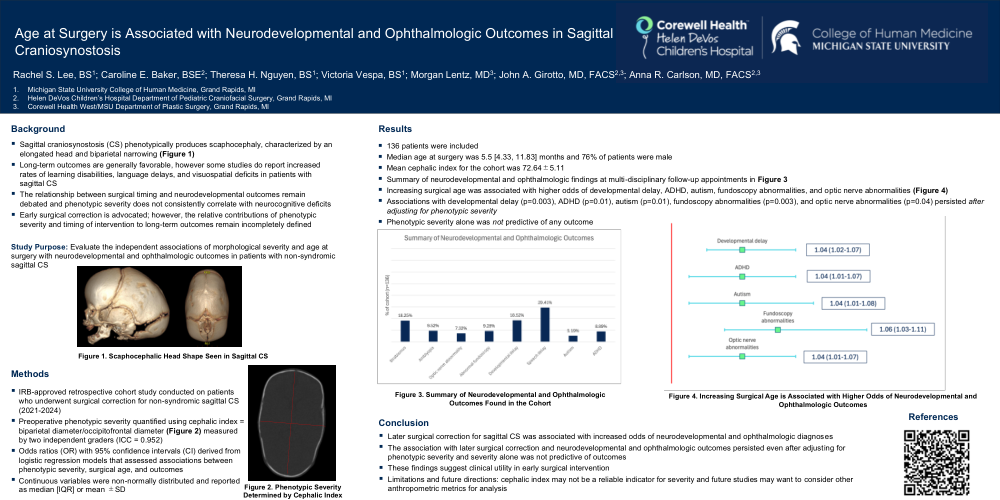
Results: Median age at surgery was 5.5 [4.33, 11.83] months and 76% of patients were male. Increasing surgical age was associated with higher odds of developmental delay (OR 1.04 [1.02-1.07], p=0.002), ADHD (OR 1.04 [1.01-1.07], p=0.009), autism (OR 1.04 [1.01-1.08], p=0.01), fundoscopy abnormalities (OR 1.06 [1.03-1.11], p=0.001), and optic nerve abnormalities (OR 1.04 [1.01-1.07], p=0.01). Associations with developmental delay (p=0.003), ADHD (p=0.01), autism (p=0.01), fundoscopy abnormalities (p=0.003), and optic nerve abnormalities (p=0.04) persisted after adjusting for phenotypic severity. Phenotypic severity alone was not predictive of any outcome.
Conclusion: Later surgical correction for sagittal CS was associated with increased odds of neurodevelopmental and ophthalmologic diagnoses, independent of cranial index. These findings suggest clinical utility in early surgical intervention.