206 posters, 13 topics, 5 sessions, 713 authors, 293 institutions
ePostersLive by SciGen Technologies S.A. All rights reserved.
AAPS 104th Annual Meeting
May 2-5, 2026 | Lihue, HI

D24
Epidemiology And Incidence Of Craniosynostosis In Puerto Rico: A Population-based Study
Poster Presenter
Authors
David A. Febre-Alemañy, Victoria I. García-Rodríguez, Adanis Bravo-Cordero, Liara S. Ortíz-Ocasio, Ángel Rivera-Barríos, Iván J. Sosa-González, Samuel Estronza-Ojeda, Jonatán Hernández-Rosa
Affiliations
San Juan Bautista School of Medicine, University of Puerto Rico, Department of Surgery, University of Puerto Rico, Department of Surgery, Division of Plastic Surgery, University of Puerto Rico, Department of Surgery, Division of Neurosurgery
Part of Topic
Craniofacial/Peds
Background:
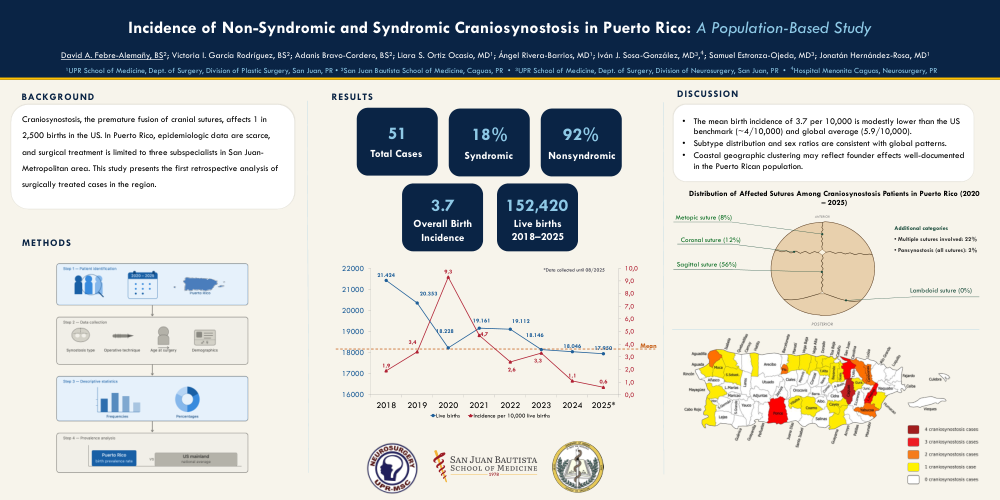
Craniosynostosis, the early fusion of cranial sutures, affects about 4 in 10,000 births in the US. In Puerto Rico, data is scarce due to inconsistent surveillance and the lack of adequate epidemiologic surveillance. Surgical treatment is limited to a few subspecialists in San Juan. This study presents the first retrospective analysis of surgically treated cases in the region.
Methods:
We conducted a retrospective review of all patients who underwent corrective surgery for craniosynostosis in PR from 2020 to 2025. Data included craniosynostosis subtype, syndromic status, surgical procedure, age at surgery, length of stay, and patient demographics. We calculated annual birth prevalence using case counts and live-birth data for Puerto Rico.
Results:
Fifty-one patients underwent surgical correction during the study: 26 (52%) were male and 24 (48%) were female, with a median age of 11 months at surgery and a mean length of stay of 2.8 ± 1.4 days. The most common subtype was sagittal synostosis (56%), and 92% of cases were non-syndromic. Annual incidence ranged from 1.9 to 9.3 per 10,000 live births, with the highest annual birth incidence observed in 2020 (9.3 per 10,000) with no significant temporal trend found in the Poisson regression analysis. The mean annual incidence across the study period was 3.7 per 10,000 live births
Conclusion:
The distribution of craniosynostosis subtypes in Puerto Rico resonates with US-mainland records, but birth incidence estimates are slightly lower. This difference likely arises from case identification issues rather than actual incidence. These findings emphasize the need for improved surveillance of congenital anomalies and better access to specialized care in Puerto Rico.