241 posters, 10 topics, 7 sessions, 899 authors, 296 institutions
ePostersLive by SciGen Technologies S.A. All rights reserved.
The AAPS 103rd Annual Meeting 2025
May 24-27, 2025 | Austin, Texas

P80
Lymphatic System Transfer with Pedicled SCIP for Patients with Lymphedema and Concomitant Chronic Venous Disease
Poster Presenter
Part of Topic
General Reconstruction
Bacground
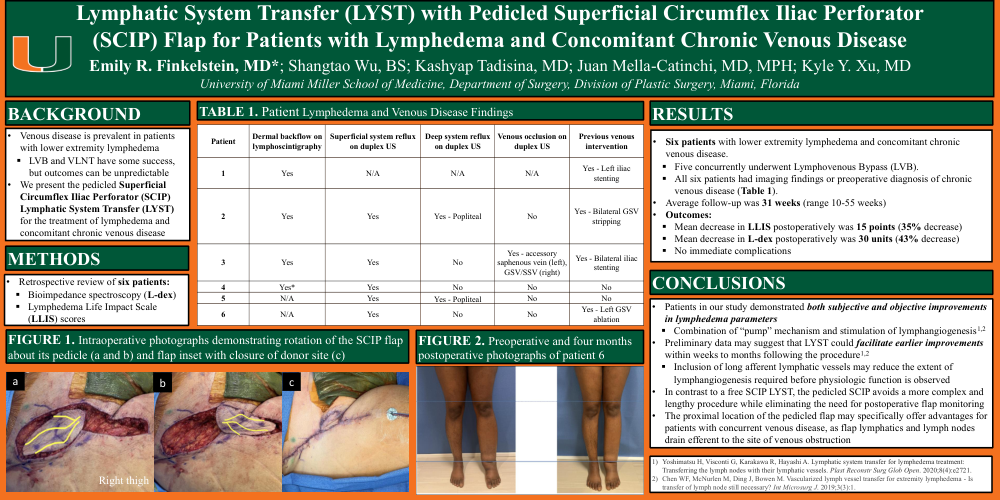
•Venous disease is prevalent in patients with lower extremity lymphedema. LVB and VLNT have some success, but outcomes can be unpredictable
•We present the pedicled Superficial Circumflex Iliac Perforator (SCIP) Lymphatic System Transfer (LYST) for the treatment of lymphedema and concomitant chronic venous disease
Methods
•Retrospective review of six patients: Bioimpedance spectroscopy (L-dex), Lymphedema Life Impact Scale (LLIS) scores
Results
•Six patients with lower extremity lymphedema and concomitant chronic venous disease. Five concurrently underwent Lymphovenous Bypass (LVB). All six patients had imaging findings or preoperative diagnosis of chronic venous disease (Table 1).
•Average follow-up was 31 weeks (range 10-55 weeks)
•Outcomes: Mean decrease in LLIS postoperatively was 15 points (35% decrease). Mean decrease in L-dexpostoperatively was 30 units (43% decrease). No immediate complications
Conclusions
•Patients in our study demonstrated both subjective and objective improvements in lymphedema parameters. Combination of “pump” mechanism and stimulation of lymphangiogenesis (1,2)
•Preliminary data may suggest that LYST could facilitate earlier improvements within weeks to months following the procedure. Inclusion of long afferent lymphatic vessels may reduce the extent of lymphangiogenesis required before physiologic function is observed (1,2)
•In contrast to a free SCIP LYST, the pedicled SCIP avoids a more complex and lengthy procedure while eliminating the need for postoperative flap monitoring
•The proximal location of the pedicled flap may specifically offer advantages for patients with concurrent venous disease, as flap lymphatics and lymph nodes drain efferent to the site of venous obstruction
Citations
1)Yoshimatsu H, Visconti G, Karakawa R, Hayashi A. Lymphatic system transfer for lymphedema treatment: Transferring the lymph nodes with their lymphatic vessels. Plast Reconstr Surg Glob Open. 2020;8(4):e2721.
2)Chen WF, McNurlen M, Ding J, Bowen M. Vascularized lymph vessel transfer for extremity lymphedema - Is transfer of lymph node still necessary? Int Microsurg J. 2019;3(3):1.