241 posters, 10 topics, 7 sessions, 899 authors, 296 institutions
ePostersLive by SciGen Technologies S.A. All rights reserved.
The AAPS 103rd Annual Meeting 2025
May 24-27, 2025 | Austin, Texas

D102
A Comparative Analysis Of Retrorectus Ventral Hernia Repair In Clean Wounds Using Biosynthetic Or Synthetic Mesh With Three-year Follow-up
Poster Presenter
Authors
Salman Khan, Margaret Hornick, Malia Voytik, Yehuda Elkaim, Robyn Broach, Stephen Kovach, John Fischer
Affiliations
Part of Topic
General Reconstruction
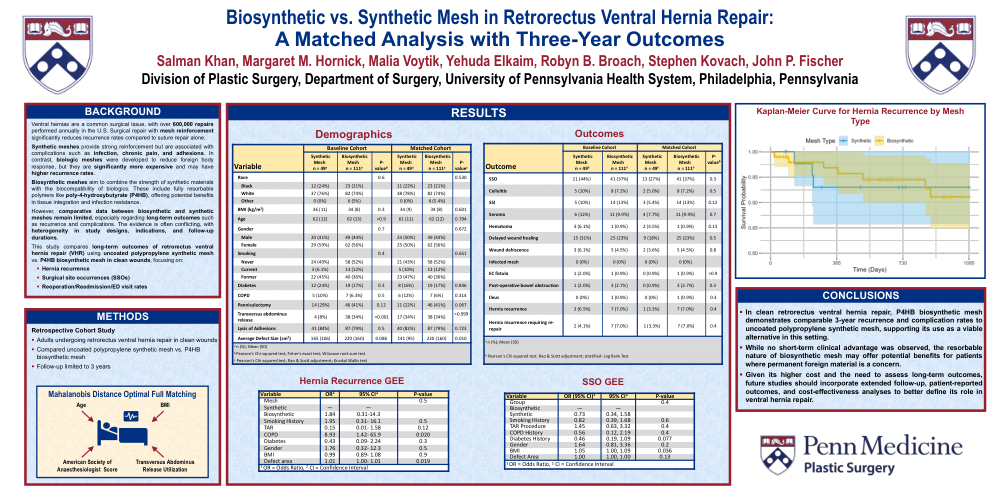
Biosynthetic vs. Synthetic Mesh in Retrorectus Ventral Hernia Repair: A Matched Analysis with Three-Year Outcomes
Background
Ventral hernias are a common surgical issue, with over 600,000 repairs performed annually in the U.S. Surgical repair with mesh reinforcement significantly reduces recurrence rates compared to suture repair alone. Synthetic meshes provide strong reinforcement but are associated with complications such as infection, chronic pain, and adhesions. In contrast, biologic meshes were developed to reduce foreign body response, but they are significantly more expensive and may have higher recurrence rates. Biosynthetic meshes aim to combine the strength of synthetic materials with the biocompatibility of biologics. These include fully resorbable polymers like poly-4-hydroxybutyrate (P4HB), offering potential benefits in tissue integration and infection resistance. However, comparative data between biosynthetic and synthetic meshes remain limited, especially regarding long-term outcomes such as recurrence and complications. The evidence is often conflicting, with heterogeneity in study designs, indications, and follow-up durations. This study compares long-term outcomes of retrorectus ventral hernia repair (VHR) using uncoated polypropylene synthetic mesh vs. P4HB biosynthetic mesh in clean wounds, focusing on:Hernia recurrence, Surgical site occurrences (SSOs), Reoperation/Readmission/ED visit rates
Methods: This single-center, retrospective cohort study included patients who underwent retrorectus VHR with biosynthetic or synthetic mesh in clean wounds between 2015 and 2021, who were followed up to hernia recurrence or three years. Optimal full matching using Mahalanobis distance, incorporating age, BMI, transversus abdominus release (TAR), and American Society of Anesthesiologists classification was performed.
Results: A total of 160 patients (49 synthetic, 111 biosynthetic) were included, with a median age and BMI of 62 years old (IQR 52.8-72.0), and 33.7 kg/m2 (28.4-39.1) respectively. Following match, baseline characteristics, comorbidities, and TAR utilization rates were comparable between groups, however biosynthetic group had a greater average defect size (220 cm2 vs 141 cm2, p=0.010). Hernia recurrence at three years did not differ significantly between the biosynthetic and synthetic mesh groups (3.3% vs. 7.0%, respectively; log-rank p=0.4). Similarly, there were no significant differences in SSOs (27% vs. 37%, p=0.3), readmission rates (17% vs. 21%, p=0.6), SSOs requiring procedural intervention (11% vs. 14%, p=0.7), or all-cause reoperation rates (17% vs. 18%, p=0.9).