241 posters, 10 topics, 7 sessions, 899 authors, 296 institutions
ePostersLive by SciGen Technologies S.A. All rights reserved.
The AAPS 103rd Annual Meeting 2025
May 24-27, 2025 | Austin, Texas

P70
Risk Management And Flap Related Outcomes In Phalloplasty For Patients With Co-morbid Conditions
Poster Presenter
Part of Topic
Gender Affirmation
Risk Management And Flap Related Outcomes In Phalloplasty For Patients With Co-morbid Conditions
Jaya K. Dhami, MD, Sara A. Alturky, BS, Elliot L. Burghardt, MD, PhD, Tara J. Brooks, MS, Monica M. Llado-Farrulla, MD, Blair R. Peters, MD,
Jens U. Berli, MD, MBA., Oregon Health & Science University, Portland, OR, USA.
Purpose
Creating an adult-sized phallus involves significant flap-related risks, with no consensus on which patient factors increase those risks or when to consider lower-risk alternatives like shaft-only phalloplasty. We present an eight-year institutional review of phalloplasty in patients with relevant comorbidities, evaluating unplanned reoperations during hospitalization and within 30 days post-discharge. By comparing outcomes between at-risk and healthy patients, we aim to guide patient selection, perioperative planning, and risk-reduction strategies in gender-affirming phalloplasty.
Methods
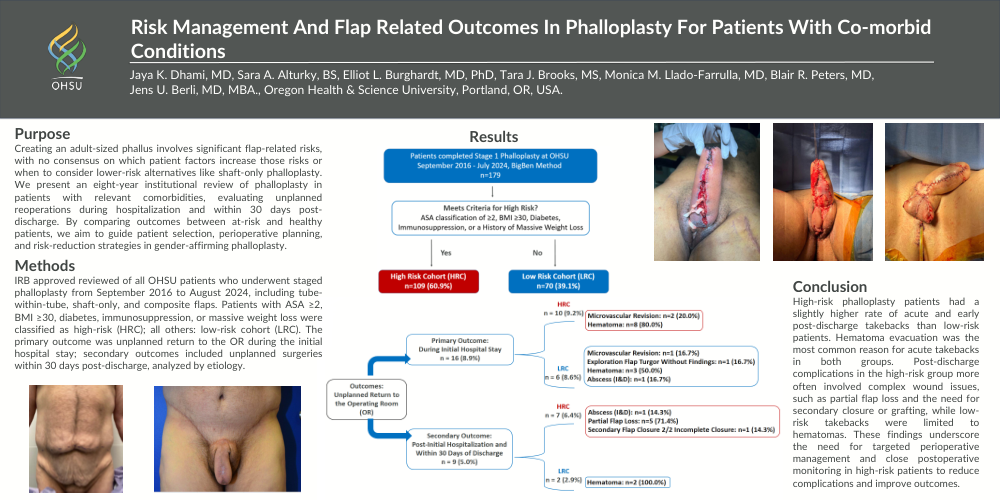
IRB approved reviewed of all OHSU patients who underwent staged phalloplasty from September 2016 to August 2024, including tube-within-tube, shaft-only, and composite flaps. Patients with ASA ≥2, BMI ≥30, diabetes, immunosuppression, or massive weight loss were classified as high-risk (HRC); all others: low-risk cohort (LRC). The primary outcome was unplanned return to the OR during the initial hospital stay; secondary outcomes included unplanned surgeries within 30 days post-discharge, analyzed by etiology.
Conclusion
High-risk phalloplasty patients had a slightly higher rate of acute and early post-discharge takebacks than low-risk patients. Hematoma evacuation was the most common reason for acute takebacks in both groups. Post-discharge complications in the high-risk group more often involved complex wound issues, such as partial flap loss and the need for secondary closure or grafting, while low-risk takebacks were limited to hematomas. These findings underscore the need for targeted perioperative management and close postoperative monitoring in high-risk patients to reduce complications and improve outcomes.