241 posters, 10 topics, 7 sessions, 899 authors, 296 institutions
ePostersLive by SciGen Technologies S.A. All rights reserved.
The AAPS 103rd Annual Meeting 2025
May 24-27, 2025 | Austin, Texas

P61
Assessing Aesthetic Training In Plastic Surgery Residency: Are We Rising To The Challenge?
Poster Presenter
Part of Topic
Education/Practice Management/Other
Assessing Aesthetic Training in Plastic Surgery Residency: Are We Rising to the Challenge?
Margaret M. Hornick MD, Malia Voytik MD, Salman Khan BS, Ayaka N. Deguchi MD, Carrie Z. Morales, Elizabeth Malphrus, Robyn Broach PhD, Saïd C. Azoury, MD
Division of Plastic Surgery, Department of Surgery, University of Pennsylvania, Philadelphia, Pennsylvania, USA
INTRODUCTION:
The number of trained Plastic and Reconstructive Surgery (PRS) providers remains relatively fixed as the demand for aesthetic surgery rapidly rises in the United States and globally.1-2
This study investigates the preparedness of PRS residents to address this demand by evaluating the aesthetic surgery training structure of PRS residency programs.
METHODS:
All ACGME-accredited independent and integrated plastic surgery program websites were reviewed for the following:
- Presence of a resident aesthetic surgery clinic (RASC)
- Presence of ≥ 1 faculty aesthetic-focused surgeon (FAFS)
- Number of graduates entering aesthetic surgery between 2019 to 2023
RESULTS:
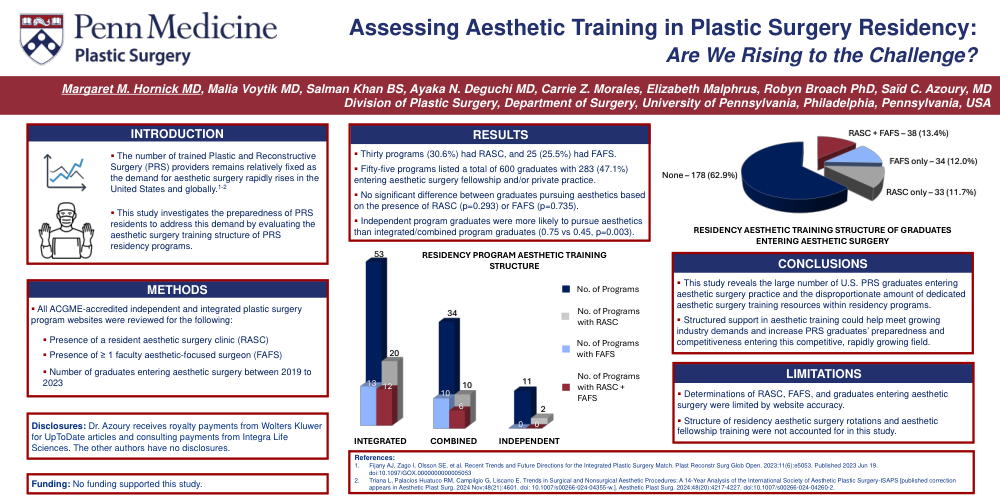
- Thirty programs (30.6%) had RASC, and 25 (25.5%) had FAFS.
- Fifty-five programs listed a total of 600 graduates with 283 (47.1%) entering aesthetic surgery fellowship and/or private practice.
- No significant difference between graduates pursuing aesthetics based on the presence of RASC (p=0.293) or FAFS (p=0.735).
- Independent program graduates were more likely to pursue aesthetics than integrated/combined program graduates (0.75 vs 0.45, p=0.003).
CONCLUSIONS:
This study reveals the large number of U.S. PRS graduates entering aesthetic surgery practice and the disproportionate amount of dedicated aesthetic surgery training resources within residency programs.
Structured support in aesthetic training could help meet growing industry demands and increase PRS graduates’ preparedness and competitiveness entering this competitive, rapidly growing field.
LIMITATIONS:
- Determinations of RASC, FAFS, and graduates entering aesthetic surgery were limited by website accuracy.
- Structure of residency aesthetic surgery rotations and aesthetic fellowship training were not accounted for in this study.