241 posters, 10 topics, 7 sessions, 899 authors, 296 institutions
ePostersLive by SciGen Technologies S.A. All rights reserved.
The AAPS 103rd Annual Meeting 2025
May 24-27, 2025 | Austin, Texas

P57
A Paradigm Shift In Integrated Plastic Surgery Residency Applications: One In Five Letters Of Recommendation Are Now Modified By Artificial Intelligence
Poster Presenter
Part of Topic
Education/Practice Management/Other
A Paradigm Shift In Integrated Plastic Surgery Residency Applications:
One In Five Letters Of Recommendation Are Now Modified By Artificial Intelligence
Transformations such as pass/fail grading1, novel curriculums2, and publication inflation3
have placed greater emphasis on qualitative and holistic factors in resident selection.
Sub-internship performance4 and letters of recommendation5 (LORs) often serve as a
central relationally-focused differentiating criteria. LORs uniquely lie largely outside the
applicant’s control and represent additional responsibility to many overtasked surgeons.
Artificial intelligence (AI) has shown potential to streamline a multitude of tasks6. The
characteristics of LOR writers for the Plastic Surgery Integrated Match as well as the
prevalence of AI-tool assistance in authoring such LORs are wholly uncharacterized.
1. Characterize the contemporary cohort of authors for letters of recommendation
(LORs) submitted for the Integrated PRS residency match.
2. Evaluate the possible prevalence of artificial intelligence (AI) assistance in LOR
composition, and identify factors independently associated with its use.
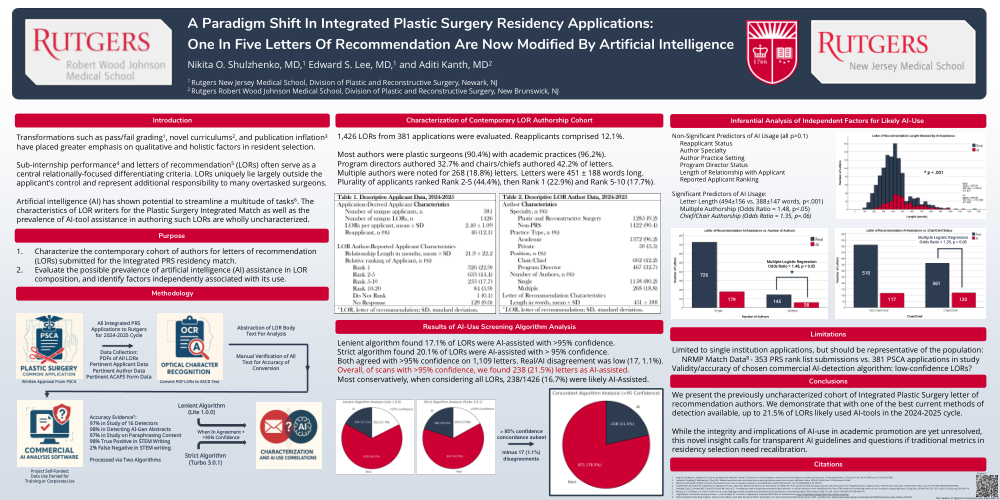
1,426 LORs from 381 applications were evaluated. Reapplicants comprised 12.1%.
Most authors were plastic surgeons (90.4%) with academic practices (96.2%).
Program directors authored 32.7% and chairs/chiefs authored 42.2% of letters.
Multiple authors were noted for 268 (18.8%) letters. Letters were 451 ± 188 words long.
Plurality of applicants ranked Rank 2-5 (44.4%), then Rank 1 (22.9%) and Rank 5-10 (17.7%).
Lenient algorithm found 17.1% of LORs were AI-assisted with >95% confidence.
Strict algorithm found 20.1% of LORs were AI-assisted with > 95% confidence.
Both agreed with >95% confidence on 1,109 letters. Real/AI disagreement was low (17, 1.1%).
Overall, of scans with >95% confidence, we found 238 (21.5%) letters as AI-assisted.
Most conservatively, when considering all LORs, 238/1426 (16.7%) were likely AI-Assisted.
Non-Significant Predictors of AI Usage (all p>0.1)
Reapplicant Status
Author Specialty
Author Practice Setting
Program Director Status
Length of Relationship with Applicant
Reported Applicant Ranking
Significant Predictors of AI Usage:
Letter Length (494±156 vs. 388±147 words, p<.001)
Multiple Authorship (Odds Ratio = 1.48, p<.05)
Chief/Chair Authorship (Odds Ratio = 1.35, p=.06)
Limited to single institution applications, but should be representative of the population:
NRMP Match Data8 - 353 PRS rank list submissions vs. 381 PSCA applications in study
Validity/accuracy of chosen commercial AI-detection algorithm: low-confidence LORs?
We present the previously uncharacterized cohort of Integrated Plastic Surgery letter of
recommendation authors. We demonstrate that with one of the best current methods of
detection available, up to 21.5% of LORs likely used AI-tools in the 2024-2025 cycle.
While the integrity and implications of AI-use in academic promotion are yet unresolved,
this novel insight calls for transparent AI guidelines and questions if traditional metrics in
residency selection need recalibration.