241 posters, 10 topics, 7 sessions, 899 authors, 296 institutions
ePostersLive by SciGen Technologies S.A. All rights reserved.
The AAPS 103rd Annual Meeting 2025
May 24-27, 2025 | Austin, Texas

P45
Combatting Provider Burnout: ChatGPT 4.0 Is Equivalent To A Plastic Surgery Provider In Answering Image-based Post Operative Patient Questions
Poster Presenter
Authors
Boris Joutovsky DO, Amanda Beneat MD, Nisha Sondhi MD, Anna Jacobs MD, Katie Weichman MD, Lawrence Draper MD
Affiliations
NYU Langone Healthcare - Long Island, New York University Long Island School of Medicine, New York University Long Island School of Medicine; Hansjorg Wyss Department of Plastic Surgery, New York University School of Medicine
Part of Topic
Outcomes
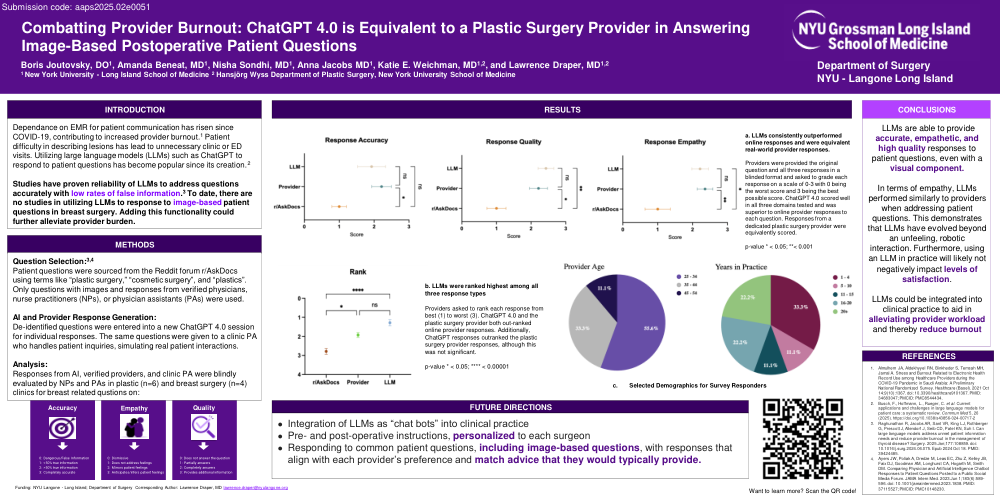
Dependance on EMR for patient communication has risen since COVID-19, contributing to increased provider burnout. Patient difficulty in describing lesions has lead to unnecessary clinic or ED visits. Utilizing large language models (LLMs) such as ChatGPT to respond to patient questions has become popular since its creation. Studies have proven reliability of LLMs to address questions accurately with low rates of false information. To date, there are no studies in utilizing LLMs to response to image-based patient questions in breast surgery. Adding this functionality could further alleviate provider burden.
Patient questions were sourced from the Reddit forum r/AskDocs using terms like “plastic surgery,” “cosmetic surgery”, and “plastics”. Only questions with images and responses from verified physicians, nurse practitioners (NPs), or physician assistants (PAs) were used. De-identified questions were entered into a new ChatGPT 4.0 session for individual responses. The same questions were given to a clinic PA who handles patient inquiries, simulating real patient interactions. Responses from AI, verified providers, and clinic PA were blindly evaluated by NPs and PAs in plastic (n=6) and breast surgery (n=4) clinics for breast related qustions on accuracy, empathy, and quality.
In conclusion, LLMs are able to provide accurate, empathetic, and high quality responses to patient questions, even with a visual component. In terms of empathy, LLMs performed similarly to providers when addressing patient questions. This demonstrates that LLMs have evolved beyond an unfeeling, robotic interaction. Furthermore, using an LLM in practice will likely not negatively impact levels of satisfaction. LLMs could be integrated into clinical practice to aid in alleviating provider workload and thereby reduce burnout.