241 posters, 10 topics, 7 sessions, 899 authors, 296 institutions
ePostersLive by SciGen Technologies S.A. All rights reserved.
The AAPS 103rd Annual Meeting 2025
May 24-27, 2025 | Austin, Texas

D145
3d Head Model With AI Pattern Recognition For The Identification Of Nerve Pain In Patients With Headache Disorders
Poster Presenter
Authors
Giulia Mönnink, Merel Hazewinkel, Weishen Pan, Thomas Campion, William Austen Jr, Darryl Sneag, Fei Wang, Lisa Gfrerer
Affiliations
Weill Cornell Medicine, Weill Cornell Medicine, Division of Plastic and Reconstructive Surgery, New York, NY, Weill Cornell Medicine, Department of Population Health Sciences, New York, NY, Weill Cornell Medicine, Clinical &Translational Sciences, New York, NY, Massachusetts General Hosptial, Division of Plastic and Reconstructive Surgery, Boston, MA, Hospital for Special Surgery, Department of Radiology and Imaging
Part of Topic
Outcomes
Title: 3D Head Model With AI Pattern Recognition For The Identification Of Nerve Pain In Patients With Headache Disorders
Background:
Nerve pain screening in patients with headache disorders requires specialized clinical knowledge that is frequently not readily accessible at the initial point-of-care. This results in restricted access to early treatment, thereby increasing the risk of chronic pain refractory to therapy and predisposing patients to long-term disability and narcotic dependence. Therefore, there is a need for a simple screening tool that enables timely and accurate diagnosis of nerve pain.
Methods:
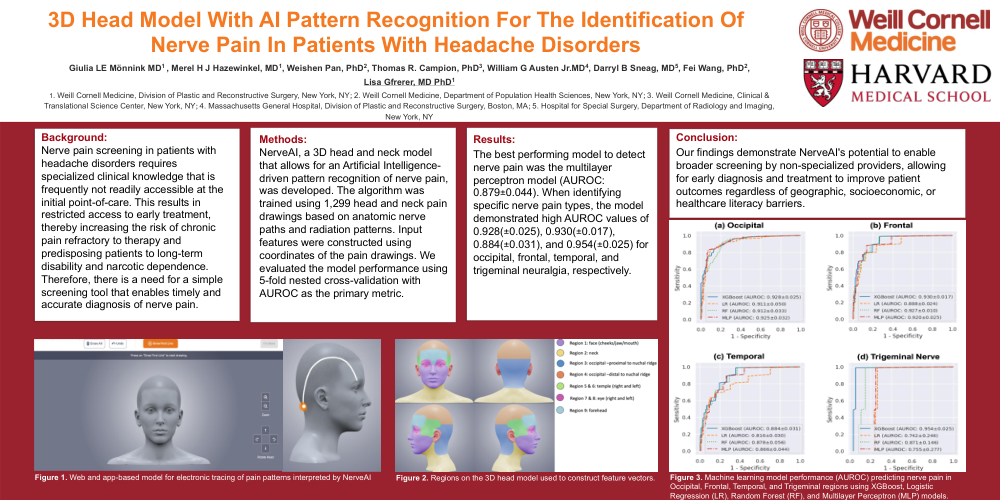
NerveAI, a 3D head and neck model that allows for an Artificial Intelligence-driven pattern recognition of nerve pain, was developed. The algorithm was trained using 1,299 head and neck pain drawings based on anatomic nerve paths and radiation patterns. Input features were constructed using coordinates of the pain drawings. We evaluated the model performance using 5-fold nested cross-validation with AUROC as the primary metric.
Results:
The best performing model to detect nerve pain was the multilayer perceptron model (AUROC: 0.879±0.044). When identifying specific nerve pain types, the model demonstrated high AUROC values of 0.928(±0.025), 0.930(±0.017), 0.884(±0.031), and 0.954(±0.025) for occipital, frontal, temporal, and trigeminal neuralgia, respectively.
Conclusion:
Our findings demonstrate NerveAI's potential to enable broader screening by non-specialized providers, allowing for early diagnosis and treatment to improve patient outcomes regardless of geographic, socioeconomic, or healthcare literacy barriers.