241 posters, 10 topics, 7 sessions, 899 authors, 296 institutions
ePostersLive by SciGen Technologies S.A. All rights reserved.
The AAPS 103rd Annual Meeting 2025
May 24-27, 2025 | Austin, Texas

P44
Artificial Intelligence Automated Segmentation of Microsurgical Instruments in Intraoperative Surgical Microscope Videos Using Convolutional Neural Networks
Poster Presenter
Authors
Affiliations
Cleveland Clinic, Cleveland Clinic Department of Plastic Surgery
Part of Topic
Education/Practice Management/Other
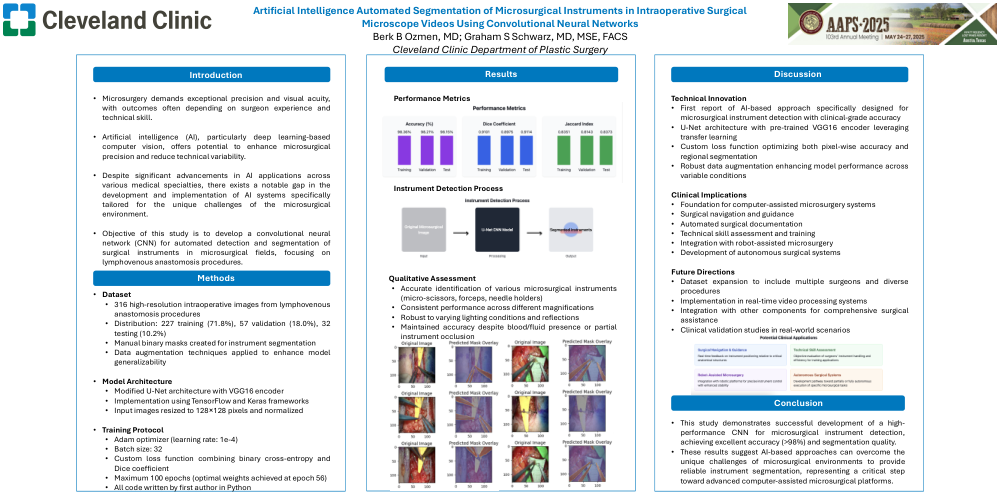
Background: Artificial intelligence (AI) integration in microsurgery represents a frontier with significant potential to enhance surgical precision. Despite advancements in computer vision and machine learning, their application in microsurgical settings remains limited. This study aims to develop a Convolutional Neural Network (CNN) for automated detection of microsurgical instruments in microsurgical fields.
Methods: A custom CNN model was developed using TensorFlow and Keras frameworks. The dataset comprised 316 high-resolution intraoperative images from lymphovenous anastomosis procedures, allocated as 227 for training, 57 for validation, and 32 for testing. A U-Net architecture with VGG16 encoder was implemented, optimized using the Adam algorithm with a hybrid loss function combining binary cross-entropy and Dice coefficient. Performance was evaluated using accuracy, loss metrics, Dice coefficient, and Jaccard index.
Results: The CNN model demonstrated exceptional performance metrics across all evaluation criteria. Test set results showed 98.15% accuracy, 0.1397 combined loss, 0.9114 Dice coefficient, and 0.8373 Jaccard index, indicating high-quality segmentation and robust instrument detection capabilities. The model maintained consistent performance under varying magnifications typical in microsurgical settings.
Conclusions: This study presents a highly accurate CNN-based AI model for microsurgical instrument detection. The robust performance suggests significant potential for integration into computer-assisted microsurgery systems and workflow potentially enhancing microsurgical outcomes. These findings provide a foundation for future development of autonomous or semi-autonomous surgical systems in microsurgery.