241 posters, 10 topics, 7 sessions, 899 authors, 296 institutions
ePostersLive by SciGen Technologies S.A. All rights reserved.
The AAPS 103rd Annual Meeting 2025
May 24-27, 2025 | Austin, Texas

P43
IMF Screws: A Favorable Alternative To Arch Bars
Poster Presenter
Part of Topic
Outcomes
IMF Screws: A Favorable Alternative to Arch Bars
Background:
Current literature offers little insight into best practices for maxillomandibular fixation (MMF) of mandible fractures. Existing studies comparing Erich arch bars (EABs) to intermaxillary fixation (IMF) screws are limited by small sample sizes and constrained sets of variables that are often subjective.1-4
Objective: To compare the outcomes of Erich arch bars versus IMF screws for closed reduction of mandible fractures.
Methods:
Part I. A retrospective chart review was conducted on patients with permanent dentition who underwent primary treatment of mandible fractures via MMF with arch bars or IMF screws at a single institution between 2009 and 2025.
Part II. Phone interviews were conducted to identify long-term postoperative occlusion (CUH IRB#23-050).
Exclusion: Concurrent Le Fort or maxillary fractures influencing occlusion, internal fixation, other MMF techniques
Outcomes: Patient demographics, Mandible Injury Severity Score,5 treatment course, complications
Statistical Analysis: Student’s t-test, Fisher’s exact test, Propensity score matching (α=0.05)
Results:
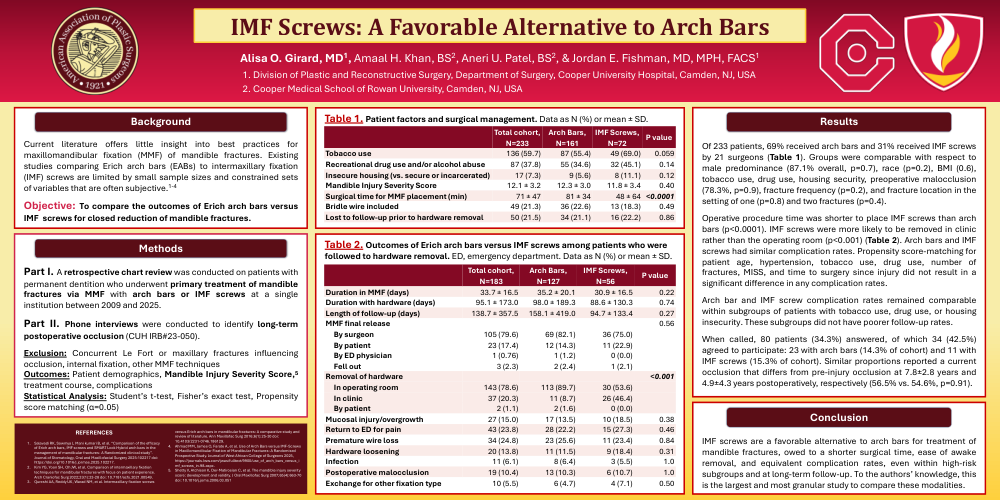
Of 233 patients, 69% received arch bars and 31% received IMF screws by 21 surgeons (Table 1). Groups were comparable with respect to male predominance (87.1% overall, p=0.7), race (p=0.2), BMI (0.6), tobacco use, drug use, housing security, preoperative malocclusion (78.3%, p=0.9), fracture frequency (p=0.2), and fracture location in the setting of one (p=0.8) and two fractures (p=0.4).
Operative procedure time was shorter to place IMF screws than arch bars (p<0.0001). IMF screws were more likely to be removed in clinic rather than the operating room (p<0.001) (Table 2). Arch bars and IMF screws had similar complication rates. Propensity score-matching for patient age, hypertension, tobacco use, drug use, number of fractures, MISS, and time to surgery since injury did not result in a significant difference in any complication rates.
Arch bar and IMF screw complication rates remained comparable within subgroups of patients with tobacco use, drug use, or housing insecurity. These subgroups did not have poorer follow-up rates.
When called, 80 patients (34.3%) answered, of which 34 (42.5%) agreed to participate: 23 with arch bars (14.3% of cohort) and 11 with IMF screws (15.3% of cohort). Similar proportions reported a current occlusion that differs from pre-injury occlusion at 7.8±2.8 years and 4.9±4.3 years postoperatively, respectively (56.5% vs. 54.6%, p=0.91).
Conclusion:
IMF screws are a favorable alternative to arch bars for treatment of mandible fractures, owed to a shorter surgical time, ease of awake removal, and equivalent complication rates, even within high-risk subgroups and at long-term follow-up. To the authors’ knowledge, this is the largest and most granular study to compare these modalities.