Loading...

241 posters, 10 topics, 7 sessions, 899 authors, 296 institutions

ePostersLive by SciGen Technologies S.A. All rights reserved.

The AAPS 103rd Annual Meeting 2025

May 24-27, 2025 | Austin, Texas

The AAPS 103rd Annual Meeting 2025 banner

D153

Patient Reported Outcomes After Surgical Treatment For Neurogenic Thoracic Outlet Syndrome With At Least 1 Year Follow-up
Part of Topic

Outcomes

INTRODUCTION

•Diagnosis of Neurogenic Thoracic Outlet Syndrome (nTOS) is challenging.
•History and Physical Examination is the Primary Method for Diagnosis
•Reporting standards by the Society of Vascular Surgeons (SVS), International Thoracic Outlet Syndrome Workgroup (INTOS) and European Association of Neurosurgical Societies (EANS) provide guidelines for Diagnosis and Treatment of nTOS. 
•The aim of this study was to analyseand present patient-reported outcomes in a cohort of patients with at least 1 year follow-up after surgical treatment for nTOS.

METHODS

•Consecutive cohort of 44 patients with NTOS
•Surgery: motor symptoms or no improvement after at least 6 months of conservative treatment
•Patient reported outcome measures
•Visual analogue scale (VAS)
•Derkash classification
•DASH
•Michigan Hand Outcomes Questionnaire
•Cervical Brachial Symptom Questionnaire (CBSQ)
 
RESULTS

nTOS site of involvement

Supraclavicular (n=12/ 27.3%)

Infraclavicular (n=16/36.4%)

Both SC and IC (n=16/ 36.4%)

Mean follow-up: 10.5 + 9.8 months

Mean duration of symptoms before surgery: 34.0 + 46.3 months

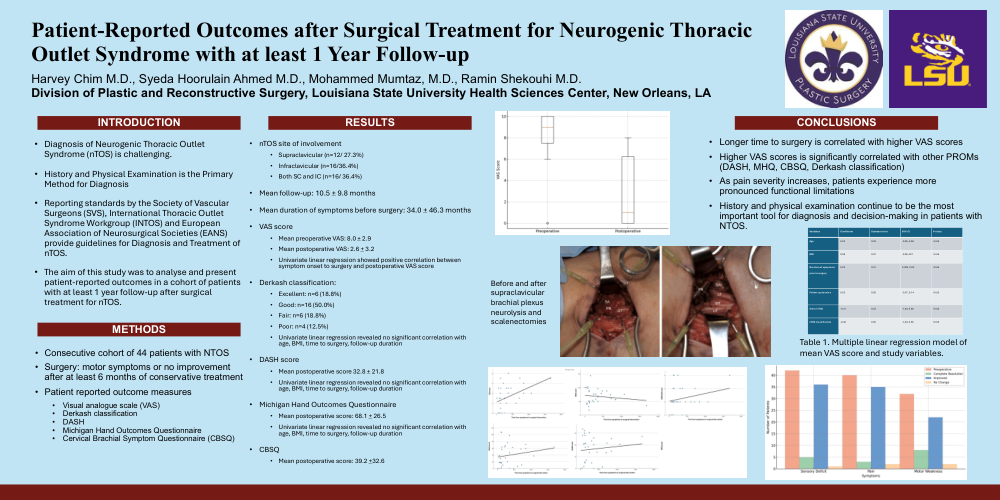
VAS score

Mean preoperative VAS: 8.0 + 2.9

Mean postoperative VAS: 2.6 + 3.2

Univariate linear regression showed positive correlation between symptom onset to surgery and postoperative VAS score

Derkash classification:

Excellent: n=6 (18.8%)

Good: n=16 (50.0%)

Fair: n=6 (18.8%)

Poor: n=4 (12.5%)

Univariate linear regression revealed no significant correlation with age, BMI, time to surgery, follow-up duration

DASH score

Mean postoperative score 32.8 + 21.8

Univariate linear regression revealed no significant correlation with age, BMI, time to surgery, follow-up duration

Michigan Hand Outcomes Questionnaire

Mean postoperative score: 68.1 + 26.5

Univariate linear regression revealed no significant correlation with age, BMI, time to surgery, follow-up duration

CBSQ

Mean postoperative score: 39.2 +32.6


CONCLUSIONS

•Longer time to surgery is correlated with higher VAS scores
•Higher VAS scores is significantly correlated with other PROMs (DASH, MHQ, CBSQ, Derkashclassification)
•As pain severity increases, patients experience more pronounced functional limitations
•History and physical examination continue to be the most important tool for diagnosis and decision-making in patients with NTOS.
aaps2025 banner
Copyright © 2015-2026, ePostersLive® SciGen is a registered trademark of SciGen Technologies S.A. Patent pending.

This website and third-party tools we use rely on cookies for the best user experience. By selecting "I agree", you agree to cookie usage as described in our Privacy Policy.