241 posters, 10 topics, 7 sessions, 899 authors, 296 institutions
ePostersLive by SciGen Technologies S.A. All rights reserved.
The AAPS 103rd Annual Meeting 2025
May 24-27, 2025 | Austin, Texas

D118
Targeted Muscle Reinnervation For Treatment Of Neuropathic Pain In Non-amputees
Poster Presenter
Authors
Floris Raasveld, Otis van Varsseveld, Caroline Hundepool, Michiel Zuidam, Jonathan Windograd, William G. Austen Jr., Ian L Valerio, Kyle R. Eberlin
Affiliations
Massachusetts General Hospital, Division of Plastic and Reconstructive Surgery, Department of General Surgery, Massachusetts General Hospital, Harvard University, Boston, MA, Erasmus MC Rotterdam, Netherlands
Part of Topic
General Reconstruction
Targeted Muscle Reinnervation (TMR) offers a promising surgical approach to prevent and treat neuropathic pain but has primarily been utilized in amputees. This study aims to describe indications and outcomes for TMR in non-amputees.
Non-amputee patients who underwent TMR for neuropathic pain at a tertiary center (2019-2024) were identified. Demographics, comorbidity, and surgical characteristics were collected through chart review. Patient satisfaction (Patient Global Impression of Change, PGIC) and quality of life (EQ-5D-5L) were assessed through a cross-sectional survey.
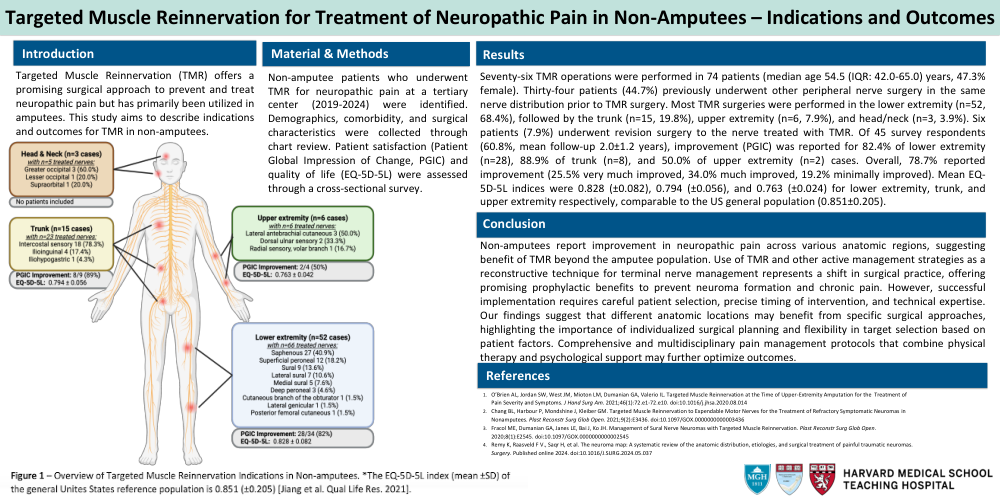
Seventy-six TMR operations were performed in 74 patients (median age 54.5 (IQR: 42.0-65.0) years, 47.3% female). Thirty-four patients (44.7%) previously underwent other peripheral nerve surgery in the same nerve distribution prior to TMR surgery. Most TMR surgeries were performed in the lower extremity (n=52, 68.4%), followed by the trunk (n=15, 19.8%), upper extremity (n=6, 7.9%), and head/neck (n=3, 3.9%). Six patients (7.9%) underwent revision surgery to the nerve treated with TMR. Of 45 survey respondents (60.8%, mean follow-up 2.0±1.2 years), improvement (PGIC) was reported for 82.4% of lower extremity (n=28), 88.9% of trunk (n=8), and 50.0% of upper extremity (n=2) cases. Overall, 78.7% reported improvement (25.5% very much improved, 34.0% much improved, 19.2% minimally improved). Mean EQ-5D-5L indices were 0.828 (±0.082), 0.794 (±0.056), and 0.763 (±0.024) for lower extremity, trunk, and upper extremity respectively, comparable to the US general population (0.851±0.205).
Non-amputees report improvement in neuropathic pain across various anatomic regions, suggesting benefit of TMR beyond the amputee population. Use of TMR and other active management strategies as a reconstructive technique for terminal nerve management represents a shift in surgical practice, offering promising prophylactic benefits to prevent neuroma formation and chronic pain. However, successful implementation requires careful patient selection, precise timing of intervention, and technical expertise. Our findings suggest that different anatomic locations may benefit from specific surgical approaches, highlighting the importance of individualized surgical planning and flexibility in target selection based on patient factors. Comprehensive and multidisciplinary pain management protocols that combine physical therapy and psychological support may further optimize outcomes.