241 posters, 10 topics, 7 sessions, 899 authors, 296 institutions
ePostersLive by SciGen Technologies S.A. All rights reserved.
The AAPS 103rd Annual Meeting 2025
May 24-27, 2025 | Austin, Texas

D116
Robotic VRAM Flap Reconstruction In APR: A Promising Approach To Reduce Abdominal Donor Site Complications
Part of Topic
General Reconstruction
Robotic VRAM Flap Reconstruction In APR: A Promising Approach To Reduce Abdominal Donor Site Complications
Eric Zeng, BS1; Stephanie Jensen, MD, MPH2; Van Christian Sanderfer, MD2; Samuel Kogan, MD, PhD3; Edward Teng, MD2
INTRODUCTION
Abdominoperineal resection (APR) for low rectal and anal cancers poses challenges in perineal wound defects –– particularly for patients who have received neoadjuvant chemotherapy and radiation.
Traditional vertical rectus abdominis myocutaneous (VRAM) flaps have proven efficacious but require large abdominal incisions, with donor site hernia rates reported up to 50%.1
Robotic techniques may offer a solution to the limitations of conventional VRAM flaps by sparing a large abdominal incision and leaving the anterior rectus fascia intact.
METHODS
A retrospective review of all patients who underwent robotic APR with VRAM by a single surgeon from 2021 to 2024 was performed.
Demographics, operative data, and complications were analyzed. Donor site hernias were diagnosed via CT imaging.
Statistical analysis was performed in R Studio using T-tests or Mann-Whitney U tests for continuous variables, Fisher’s Exact tests for categorical variables, Shapiro-Wilk tests for normality, and logistic regression modeling to adjust for covariates.
OBJECTIVE
To assess rates of abdominal hernia and bulge in patients undergoing robotic VRAM flap harvest and compare to published data of conventional open VRAM harvest.
RESULTS
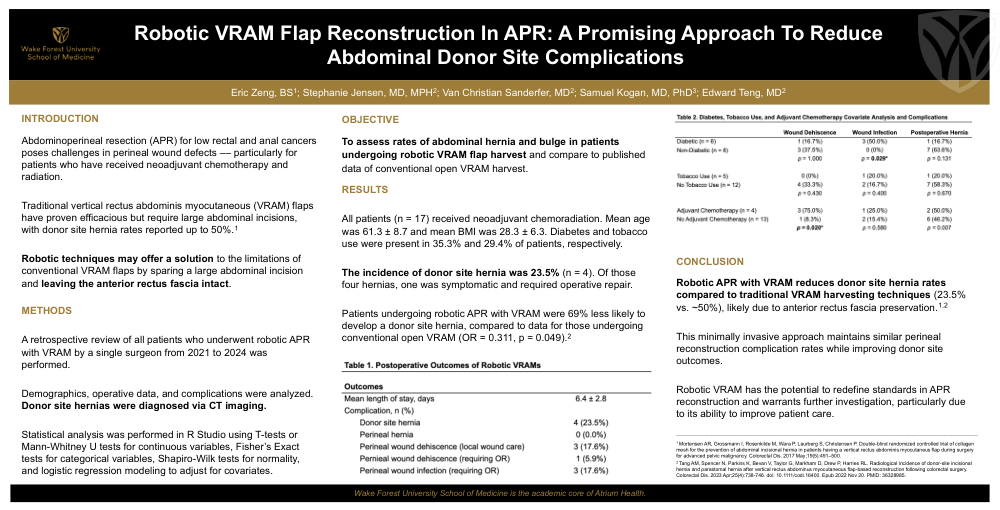
All patients (n = 17) received neoadjuvant chemoradiation. Mean age was 61.3 ± 8.7 and mean BMI was 28.3 ± 6.3. Diabetes and tobacco use were present in 35.3% and 29.4% of patients, respectively.
The incidence of donor site hernia was 23.5% (n = 4). Of those four hernias, one was symptomatic and required operative repair.
Patients undergoing robotic APR with VRAM were 69% less likely to develop a donor site hernia, compared to data for those undergoing conventional open VRAM (OR = 0.311, p = 0.049).2
CONCLUSION
Robotic APR with VRAM reduces donor site hernia rates compared to traditional VRAM harvesting techniques (23.5% vs. ~50%), likely due to anterior rectus fascia preservation.1,2
This minimally invasive approach maintains similar perineal reconstruction complication rates while improving donor site outcomes.
Robotic VRAM has the potential to redefine standards in APR reconstruction and warrants further investigation, particularly due to its ability to improve patient care.