Loading...

241 posters, 10 topics, 7 sessions, 899 authors, 296 institutions

ePostersLive by SciGen Technologies S.A. All rights reserved.

The AAPS 103rd Annual Meeting 2025

May 24-27, 2025 | Austin, Texas

The AAPS 103rd Annual Meeting 2025 banner

D108

Impact Of Muscle Flap Reconstruction After Spine Surgery: A Systematic Review And Meta-Analysis
Part of Topic

General Reconstruction

Impact of Muscle Flap Closure After Spine Surgery: A Systematic Review and Meta-Analysis

Dylan K. Kim AB1, Kathleen Gu BS1, Anthony J. Tang BBA BSA1, Andrew K. Chan MD2, Jarrod T. Bogue MD1, Thomas A. Imahiyerobo MD1, Christine H. Rohde MD MPH1

1Division of Plastic and Reconstructive Surgery, Columbia University Irving Medical Center

2Department of Neurosurgery, Columbia University Irving Medical Center


Introduction

Spine surgery comprises a diverse range of procedures that may be associated with significant comorbidity burden and postoperative risk. Muscle flap closure after spine surgery has been associated with improvements in postoperative complications, particularly in high-risk cases, via reduction of dead space, increased tissue vascularization, and reduction of tension along the wound edges.

Despite such benefits described in existing literature, there is a general lack of high-level evidence investigating muscle flap utilization in spine surgery. This study provides a systematic review and pooled analysis of characteristics and outcomes of muscle flap closure after spine surgery.


Methods

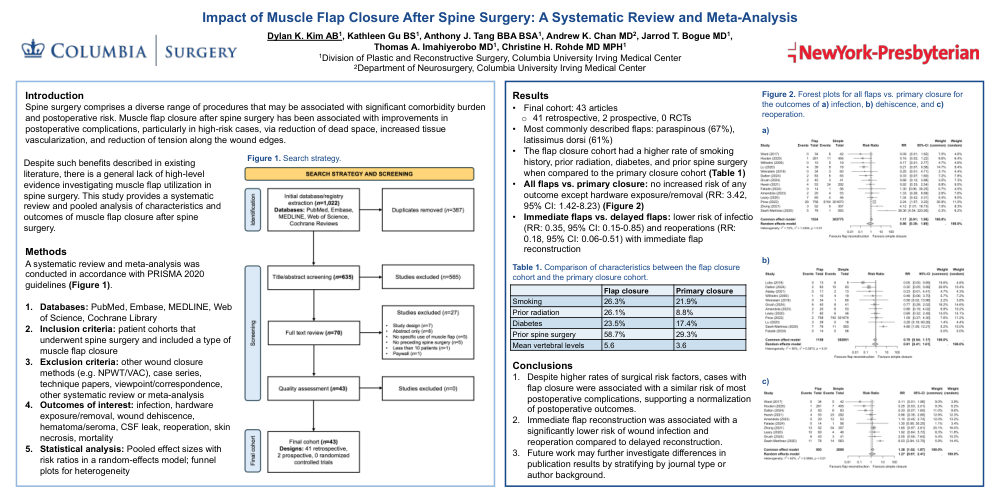
A systematic review and meta-analysis was conducted in accordance with PRISMA 2020 guidelines (Figure 1).

1.Databases: PubMed, Embase, MEDLINE, Web of Science, Cochrane Library
2.Inclusion criteria: patient cohorts that underwent spine surgery and included a type of muscle flap closure
3.Exclusion criteria: other wound closure methods (e.g. NPWT/VAC), case series, technique papers, viewpoint/correspondence, other systematic review or meta-analysis
4.Outcomes of interest: infection, hardware exposure/removal, wound dehiscence, hematoma/seroma, CSF leak, reoperation, skin necrosis, mortality
5.Statistical analysis: Pooled effect sizes with risk ratios in a random-effects model; funnel plots for heterogeneity
 

Results

•Final cohort: 43 articles
o41 retrospective, 2 prospective, 0 RCTs
•Most commonly described flaps: paraspinous (67%), latissimus dorsi (61%)
•The flap closure cohort had a higher rate of smoking history, prior radiation, diabetes, and prior spine surgery when compared to the primary closure cohort (Table 1)
•All flaps vs. primary closure: no increased risk of any outcome except hardware exposure/removal (RR: 3.42, 95% CI: 1.42-8.23) (Figure 2)
•Immediate flaps vs. delayed flaps: lower risk of infection (RR: 0.35, 95% CI: 0.15-0.85) and reoperations (RR: 0.18, 95% CI: 0.06-0.51) with immediate flap reconstruction


Conclusions

1.Despite higher rates of surgical risk factors, cases with flap closure were associated with a similar risk of most postoperative complications, supporting a normalization of postoperative outcomes.
2.Immediate flap reconstruction was associated with a significantly lower risk of wound infection and reoperation compared to delayed reconstruction.
3.Future work may further investigate differences in publication results by stratifying by journal type or author background.


aaps2025 banner
Copyright © 2015-2026, ePostersLive® SciGen is a registered trademark of SciGen Technologies S.A. Patent pending.

This website and third-party tools we use rely on cookies for the best user experience. By selecting "I agree", you agree to cookie usage as described in our Privacy Policy.