241 posters, 10 topics, 7 sessions, 899 authors, 296 institutions
ePostersLive by SciGen Technologies S.A. All rights reserved.
The AAPS 103rd Annual Meeting 2025
May 24-27, 2025 | Austin, Texas

P77
Longitudinal Comparison Of Quantitative Sensory Outcomes In Patients With Direct-to-implant Breast Reconstruction With Nerve Allograft And Gender-affirming Mastectomy With Direct Nerve Coaptation
Poster Presenter
Part of Topic
Gender Affirmation
Quantitative Sensory Outcomes in Direct-to-Implant Breast Reconstruction and Gender-Affirming Mastectomy
Study Aim: Compare sensory outcomes in patients undergoing targeted NAC reinnervation with DTI breast reconstruction using nerve allografts and GAM utilizing direct coaptation
Methods:
Prospective cohort study with DTI reconstruction (32 subjects & 24 controls) and GAM (37 subjects & 32 controls). Quantitative Sensory Testing (QST) was performed at baseline and postoperatively (3, 6, and 12 months). Univariate analysis assessed differences between groups at each time point and to their respective controls.
Results:
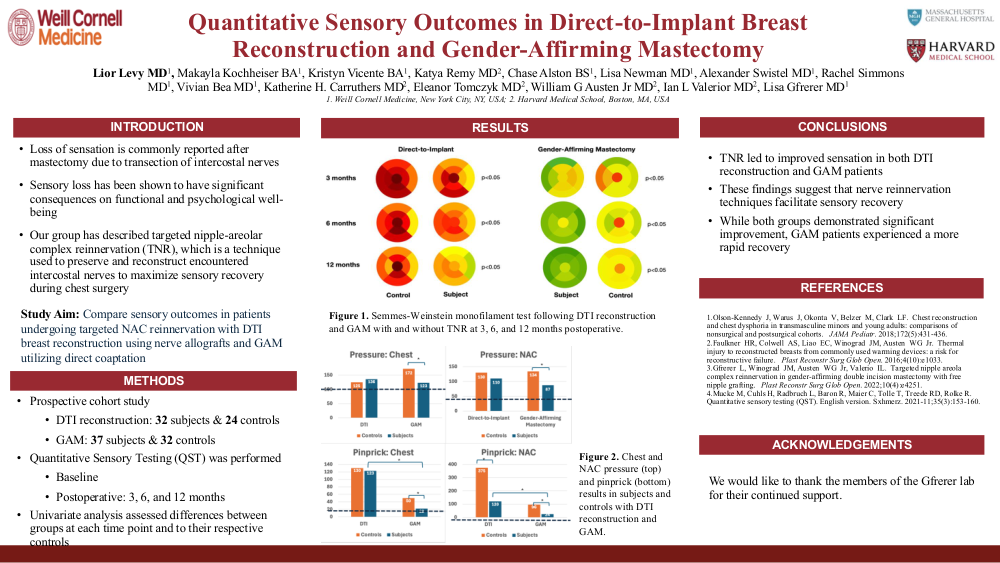
Postoperatively, monofilament testing was significantly better at the chest and NAC in GAM patients at each timepoint (p<0.05). At 12 months, all sensory tests were significantly better at the chest in GAM patients except for pressure, which was similar between groups. Pinprick was significantly better at the NAC in GAM patients, while pressure was similar. At 12 months, all sensory tests had returned to baseline in the GAM group except chest pressure and NAC pinprick.
Conclusions:
TNR led to improved sensation in both DTI reconstruction and GAM patients. These findings suggest that nerve reinnervation techniques facilitate sensory recovery. While both groups demonstrated significant improvement, GAM patients experienced a more rapid recovery.