241 posters, 10 topics, 7 sessions, 899 authors, 296 institutions
ePostersLive by SciGen Technologies S.A. All rights reserved.
The AAPS 103rd Annual Meeting 2025
May 24-27, 2025 | Austin, Texas

D78
The Impact Of Educating Floor Nurses Through The Use Of Individualized Explanatory Videos On Limb Reconstruction Patient Aftercare - Preliminary Results On Satisfaction Of Patients And Providers
Poster Presenter
Authors
Laura Hilbig-Vlatten, Lilly F Stadelmeier, Toni F Engmann, Raffaela Faulhaber, Mario Keko, Arriyan S Dowlatshahi
Affiliations
Beth Israel Deaconess Medical Center, Division of Orthoplastic and Reconstructive Microsurgery, Beth Israel Deaconess Medical Center, Division of Orthoplastic and Reconstructive Microsurgery, Engmann, Department of Orthopaedic Surgery, Beth Israel Deaconess Medical Center
Part of Topic
Education/Practice Management/Other
BACKGROUND:
Rising Relevance of Microsurgical Flaps in Limb Reconstruction:
- Managing complex extremity defects of various etiologies, offering limb salvage, functional restoration, and aesthetic benefits.
- Valuable alternative to other treatment options, such as amputation, despite the presence of certain risk factors.
- 5-year survival rate is significantly higher in patients who received flaps compared to the amputated patients.
High Stakes in Postoperative Monitoring:
- Vascular compromise remains a critical threat to flap viability, necessitating close, standardized monitoring.
- Effective interdisciplinary communication and patient involvement are crucial for optimal outcomes.
METHODS:
Design: Prospective randomized unblinded controlled study at BIDMC (May 2022 - Jan 2025)
- Adult patients (≥18 years) who underwent upper or lower extremity reconstruction using a free or pedicled flap requiring inpatient postop monitoring.
Participants: 40 patients, either randomized to control (n=20, no video) or intervention (n=20, video)
Intervention: brief individualized video (<3 min)
- Recorded postoperatively by the surgeon, highlighting indications for surgery and important aspects of postop care; available to the care team via secure iPads, with optional patient viewing.
Data Collection: 12-item quality of care questionnaire utilizing a Likert scale was administered to providers and patients before discharge.
- Assessing communication clarity, care coordination, perceived stress and satisfaction.
RESULTS:
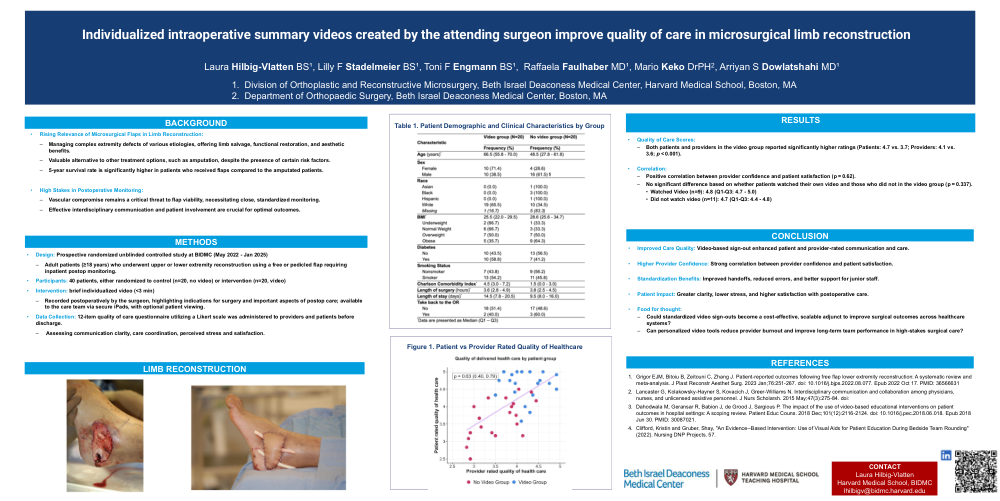
Quality of Care Scores: Both patients and providers in the video group reported significantly higher ratings (Patients: 4.7 vs. 3.7; Providers: 4.1 vs. 3.6; p < 0.001).
Correlation:
- Strong correlation between provider confidence and patient satisfaction (p = 0.62).
- No significant difference based on whether patients watched their own video and those who did not in the video group (p = 0.337).
- Watched video (n=9): 4.8
- Did not watch video (n=11): 4.7
CONCLUSION:
Improved Care Quality: Video-based sign-out enhanced patient and provider-rated communication and care.
Higher Provider Confidence: Strong correlation between provider confidence and patient satisfaction.
Standardization Benefits: Improved handoffs, reduced errors, and better support for junior staff.
Patient Impact: Greater clarity, lower stress, and higher satisfaction with postoperative care.
Food for thought:
Could standardized video sign-outs become a cost-effective, scalable adjunct to improve surgical outcomes across healthcare systems?
Can personalized video tools reduce provider burnout and improve long-term team performance in high-stakes surgical care?
Title: The Impact Of Educating Floor Nurses Through The Use Of Individualized Explanatory Videos On Limb Reconstruction Patient Aftercare - Preliminary Results On Satisfaction Of Patients And Providers